FAR & Beyond: The RFO’s Expansion of BPAs: Revolutionary Common Sense
For almost 30 years, the General Services Administration’s (GSA’s) Multiple Award Schedule (MAS) program has included the ability for customer agencies to award Blanket Purchase Agreements (BPAs) under MAS contracts. Under the MAS program, BPAs drive competition, value, and pricing for customer agencies. BPAs empower agencies to consolidate and compete repetitive needs for supplies and/or services utilizing the MAS ordering procedures.
MAS BPAs are a procurement management tool, allowing agencies to structure procurement operations to more efficiently and effectively support the repetitive needs of specific agency programs. Over the years, BPAs have grown in popularity with customer agencies, accounting for just over half of the dollar volume under the MAS program. Agencies use BPAs to consolidate repetitive requirements for a host of commercial products, including office supplies, information technology (IT), maintenance repair and operations (MRO) supplies, and furniture. Agencies also use BPAs to manage repetitive professional services requirements in support of agency mission requirements. Not only do MAS BPAs leverage volume buying to achieve lower prices, but they also reduce administrative burdens and time to market for customer agencies.
Over the last four years, BPAs have averaged just over 50 percent of the dollar volume under the MAS program.
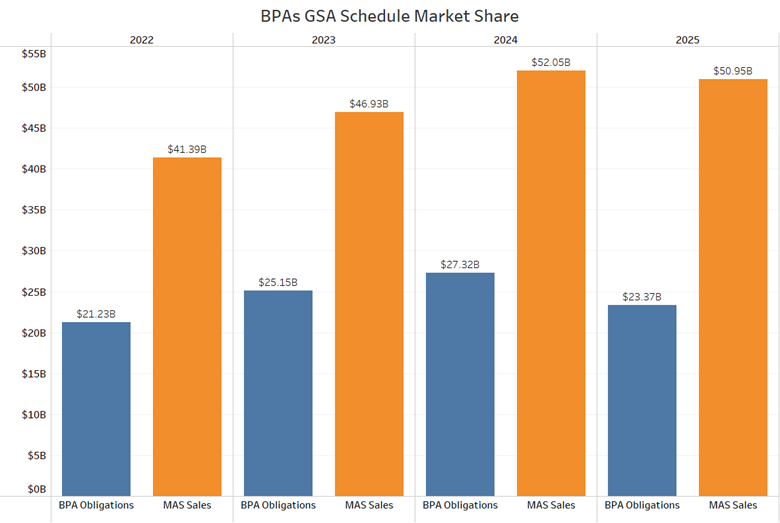
As the chart demonstrates, MAS BPAs play a significant, positive role in supporting agency missions. Now, the opportunities for customer agencies to leverage BPAs have increased thanks to the Revolutionary Federal Acquisition Regulation (FAR) Overhaul (RFO).
The RFO made significant, common-sense regulatory changes that will expand the effectiveness and overall use of BPAs under multiple award contracts. First, the MAS ordering procedures, now found at General Services Acquisition Regulation (GSAR) Subpart 538.71, expanded the potential use of single award BPAs. Competition for single award MAS BPAs for agency specific requirements is one of most effective ways to increase value and lower total acquisition costs for customer agencies and the American people. The Coalition for Common Sense for Government Procurement (Coalition) has consistently supported the expansion of the use of single award MAS BPAs as a market driven, best value procurement tool.
Second, the RFO authorizes the establishment of BPAs under all multiple award contracts. See RFO 16.507-2(c)(3). As a result, governmentwide contracting programs like OASIS+, NASA SEWP VI, and Alliant 3 will now have greater flexibility to leverage repetitive requirements to achieve greater efficiency and lower performance costs. BPAs under the IT governmentwide acquisition contracts (GWACs) now provide a procurement management function that will support agency-specific program missions in an even more efficient and effective manner. Likewise, agency-specific multiple award contracts can now leverage this authority as part of their acquisition strategy. The key trigger for the authorization is that the underlying multiple award contract includes language specifically authorizing BPAs at the competitive ordering level.
These common-sense regulatory changes will create dynamic opportunities that will enhance competition, lower costs/prices, and achieve best value for customer agencies. The framework has been set, and formal rulemaking will finalize these changes. The ultimate key to success will be the ability of the acquisition workforce to creatively and effectively utilize BPAs. Training is critical. Identifying and sharing best practices across government will help ensure the potential of BPAs is fulfilled. The RFO eliminates the checklist approach to procurement and rightly invests the acquisition workforce with great discretion in executing the mission. Training, professional development, and communication are foundational to the long-term success of the RFO.
The Coalition stands ready to work with all stakeholders in identifying best practices that support the efficient and effective procurement tools that deliver best value mission support for the American people.
Registration Now Open: 2026 Spring Training Conference, May 13- 14
Registration is now open for the Coalition’s 2026 Spring Training Conference, taking place on May 13–14, 2026, at the Fairview Marriott in Falls Church, Virginia!
This year’s Spring Training Conference will examine next steps in the Revolutionary Federal Market, continuing important conversations from January’s Winter Training Conference on the latest developments shaping federal procurement.
The two-day program will focus on governmentwide and healthcare procurement issues, providing timely insights into policy developments, market trends, and agencies’ acquisition priorities. Sessions will explore evolving compliance requirements, emerging acquisition strategies, and key initiatives affecting contractors and agencies. Attendees will hear directly from government decision makers and industry experts on what lies ahead in the dynamic federal procurement landscape.
Register today to secure your spot and stay ahead in the federal market! To register for the Spring Training Conference, click here. For assistance with registration, please contact Mady Whiting at mady.whiting@thecgp.org.
Stay tuned for more conference announcements in the coming weeks.
Hotel Reservations
Please use this link to secure your room in our block at the discounted rate before April 27, 2026: Book your group rate for CGP Spring Training Conference
Secure Yours Today – Sponsorship Opportunities Still Available!
With a highly targeted audience of government decision-makers, procurement leaders, and industry experts, sponsors of the Spring Training Conference gain direct engagement with stakeholders who influence acquisition policy and purchasing priorities.
Through event promotions, on-site recognition, and networking opportunities, sponsors can strengthen brand recognition, demonstrate market leadership, and build relationships that support long-term growth.
View the opportunities here and secure your sponsorship today! If you have any questions, or are ready to secure your sponsorship, please contact Heather Tarpley at htarpley@thecgp.org.
Thank You to Our Current Spring Training Conference Sponsors!
GSA Announces Alliant 3 Phase One Awards
The General Services Administration (GSA) announced the phase one contract awards under the Alliant 3 Governmentwide Acquisition Contract (GWAC). GSA determined that a phased award approach is in the best interest of the Government and consistent with the solicitation’s evaluation process.
GSA received 133 proposals in response to the solicitation and has identified 43 offerors eligible for award in phase one. The agency intends to make up to 76 total awards (plus ties) as additional phases are completed.
No offerors have been eliminated from consideration. Offerors not selected in this phase remain eligible for future award phases and will be notified of their status as the process continues.
SEWP VI Protests Could Delay Contract Awards
Washington Technology reports that several companies have filed protests with the Government Accountability Office (GAO) after being eliminated from consideration for the $60 billion Solutions for Enterprise-Wide Procurement (SEWP) VI governmentwide acquisition contract.
Eight companies filed protests between February 17 and February 20. NASA has not yet announced SEWP VI awardees. GAO decisions are expected between May 28 and June 1 unless NASA takes corrective action.
The protests could delay the award timing of SEWP VI, as SEWP V is currently set to expire on April 30. NASA may extend SEWP V if the protests are not resolved before that date.
MAS Refresh 31 Release Delayed
GSA has shared an updated notice for Multiple Award Schedule (MAS) Refresh 31. To ensure all changes are fully integrated, Refresh 31 will now be released in March or April. GSA recommends that any non-Transactional Data Reporting (TDR) offers not yet submitted begin transitioning to the TDR format in preparation for submission. All new offers submitted after Refresh 31 will be required to follow the TDR format.
To view all major upcoming changes associated with Refresh 31, click here.
FAR Part 19 Model Deviation Updated Following eSRS Transition
GSA decommissioned the Electronic Subcontracting Reporting System (eSRS.gov) on February 20, moving subcontracting reporting to SAM.gov.
To align with this change, the Federal Acquisition Regulation (FAR) Council has amended the FAR Part 19 model deviation text.
See these resources for more information:
- The GSA deviation supplement for more background information, a high-level summary of changes, and instructions for the GSA acquisition workforce;
- The updated FAR Part 19 model deviation text on the FAR Overhaul page on Acquisition.gov; and
- The updated FAR Part 19 Practitioner Album on the FAR Overhaul page on Acquisition.gov with the Line-in Line-out changes.
GAO Seeks Member Feedback on HHS and IHS Contracting Changes
The Government Accountability Office (GAO) has reached out to the Coalition for information regarding the effect of contracting workforce changes since January 2025 on the Department of Health and Human Services (HHS). GAO has expressed particular interest in the effect of workforce changes on the Indian Health Service (IHS). In addition to workforce changes, GAO is also interested in the impact of funding changes on IHS contracts since January 2025 . GAO’s goal is to gather information on the scale and impact of recent changes in workforce and contracting. Particular areas of interest include:
- Known changes or challenges with HHS contracting since January 2025, particularly with IHS.
- Known extent and impact of HHS contracting delays, terminations, or reductions since January 2025, particularly with IHS.
- Any knowledge regarding information received from HHS as it relates to contract delays, terminations, or reductions since January 2025.
Please provide any comments, insights, or questions to Joseph Snyderwine at jsnyderwine@thecgp.org by COB today, February 27.
State Department Awards Evolve IT Modernization Contracts
FedScoop reports that the Department of State has awarded indefinite-delivery, indefinite-quantity (IDIQ) contracts to 28 vendors under the Evolve program which is designed to modernize the agency’s global IT infrastructure.
The awards span five functional categories:
- IT management;
- Cloud and data centers;
- Application development;
- Network and telecommunications; and
- End user support.
The contract vehicle carries a $10 billion ceiling and includes a one-year base period with six one-year option periods. Cloud and data center services and application development received the highest number of awards, with 14 and 13 awardees respectively. IT management has 11 awardees, while network and telecommunications has six and end user support has four awardees.
Army Tests AI Tools to Accelerate Procurement Processes
The Defense Visual Information Distribution Service (DVIDS) recently reported that the Army anticipates making fiscal year 2026 Small Business Innovation Research (SBIR) awards for two AI–enabled source selection tools. The tools are being developed under Army Contracting Command’s (ACC) Smart Contracting Initiative, which is intended to accelerate and improve procurement processes.
In addition to source selection tools, ACC has been piloting AI-enabled technologies designed to streamline the development of Acquisition Requirement Packages (ARPs). ARPs are collections of documents that define what the government intends to procure and how the acquisition complies with applicable laws and regulations. One prototype tool has demonstrated the ability to generate ARPs in significantly less time, helping acquisition teams reduce administrative burden and improve consistency across procurement documents.
Army officials reported that the technology has already supported supply-type contract awards and may be expanded to support service acquisitions and other phases of the acquisition lifecycle. ACC anticipates continued development of AI-enabled tools to support additional procurement functions and improve efficiency across the acquisition process.
OIG Review Identifies Call Center Oversight Issues at VHA Facilities
The Department of Veterans Affairs (VA) Office of Inspector General (OIG) issued a preliminary results advisory memorandum finding that most Veterans Health Administration (VHA) facilities are not adequately tracking specialty care call center performance metrics. Thirteen of the 15 medical centers reviewed lacked data on abandoned calls and wait times, leaving nearly one million call attempts, particularly in radiology and mental health, untracked. This potentially affects veterans’ timely access to care.
Veterans told investigators they experienced difficulties reaching clinics by phone, sometimes requiring in-person visits. The OIG warned that without stronger oversight, VHA may miss access delays or fail to take corrective action. The review remains ongoing.
Meritalk reports VA Press Secretary Pete Kasperowicz said that the department is working to make improvements and to strengthen phone-based customer service and performance tracking.
GSA Launches Webpage for OASIS+ Solicitations
GSA has launched a new webpage dedicated to its six continuously open OASIS+ solicitations, providing a centralized resource for contractors seeking to understand and participate in these ongoing opportunities. GSA will update the webpage as new information becomes available.
The page includes:
- An overview explaining what “continuously open” means and which solicitations are available;
- Guidance on how submissions are processed and how rolling awards are managed;
- Frequently asked questions about OASIS+ solicitations; and
- Instructions for submitting questions and accessing the Q&A process.
According to GSA, the resource is intended to provide stakeholders with a single, up-to-date source for solicitation details, helping contractors understand requirements, locate relevant documents, and navigate the submission process.
VA FSS Releases Quarterly Newsletter with Program Updates
The Department of Veterans Affairs (VA) Federal Supply Schedule (FSS) program has released the latest edition of its quarterly newsletter, highlighting several upcoming initiatives and program updates.
The newsletter indicates that a refreshed public website will be launched soon and previews a potential effort to extend VA FSS contract terms. Currently, VA FSS contracts include a five-year base period and one five-year option. VA is considering expanding the structure to allow up to three five-year options, which would increase the maximum contract term from 10 to 20 years if all options are exercised.
The newsletter also discusses VA’s transition to a “One VA” enterprise model, provides updated VA FSS contracting statistics, and includes additional information relevant to VA FSS contractors.
Off the Shelf: A Postmortem on CIO-SP4
Brian Friel, Owner of BD Squared, joined Off the Shelf to address the state of governmentwide contracting.
During the interview, Friel gives a postmortem on CIO-SP4, including lessons learned and pitfalls to avoid when utilizing a self-scoring evaluation model.
He also gives an update on OASIS+ and the IT GWACs, including NASA SEWP VI, POLARIS, Alliant 3, and highlights the Alliant’s programs major step forward in announcing the first set of awardees.
In addition, Friel shares his thoughts on the Army MAPS procurement.
Listen to the full podcast here.
Pentagon Seeks Industry Input on FAR and DFARS Changes
Under Secretary of Defense for Acquisition and Sustainment Michael Duffey invited defense industrial base stakeholders to propose changes to the FAR and Defense FAR Supplement (DFARS). The request is tied to Phase 2 of the Revolutionary FAR Overhaul (RFO), which will use formal rulemaking to codify recent RFO class deviations.
The Pentagon is seeking recommendations that help the government:
- Field technology and modernize systems at a pace that outmatches adversaries;
- Increase production capacity to support wartime surge requirements; and
- Place the acquisition system and industrial base on a wartime footing.
Feedback can be submitted to John Tenaglia and Kimberly Ziegler at osd.pentagon.ousda-s.mbx.dfars@mail.mil.
The Coalition plans to respond to this request. Members wishing to provide input should email their thoughts to Greg Waldron at gwaldron@thecgp.org as soon as possible.
Imaging Equipment and Furniture Committee Meeting with GSA, March 11
The Coalition’s Imaging Equipment and Furniture Committees will host a meeting with GSA’s Greg Rollins, Deputy Assistant Commissioner, Office of Policy and Compliance, Steven Hutchinson, Chief of MAS Policy, Office of Policy and Compliance, and Paula Hance, Procurement Analyst, General Supplies and Services, to discuss the implementation of Transactional Data Reporting (TDR), with a focus on addressing issues TDR presents for highly configurable items. The meeting will be held virtually on March 11 at 10:00 AM ET.
Please submit questions to be discussed at the meeting to Joseph Snyderwine at JSnyderwine@thecgp.org.
To register, click here. For assistance with registration, please contact Mady Whiting at mady.whiting@thecgp.org
This is a members-only event. If you see a message that says “Registration Not Available” below, please log in using your member account.
Cyber & Supply Chain Security Committee Meeting: Cyber Update, April 8
The Coalition’s Cyber & Supply Chain Security Committee will host a meeting with Townsend Bourne, Partner at Sheppard Mullin, and Michael Gruden, Partner at Crowell & Moring. Townsend and Michael will provide the latest updates on federal cybersecurity policy developments and what they mean for contractors. The meeting will be held virtually on April 8 at 12:00 PM ET.
To register, click here. For assistance with registration, please contact Mady Whiting at mady.whiting@thecgp.org
This is a members-only event. If you see a message that says “Registration Not Available” below, please log in using your member account.