For almost 30 years, the General Services Administration’s (GSA’s) Multiple Award Schedule (MAS) program has included the ability for customer agencies to award Blanket Purchase Agreements (BPAs) under MAS contracts. Under the MAS program, BPAs drive competition, value, and pricing for customer agencies. BPAs empower agencies to consolidate and compete repetitive needs for supplies and/or services utilizing the MAS ordering procedures.
MAS BPAs are a procurement management tool, allowing agencies to structure procurement operations to more efficiently and effectively support the repetitive needs of specific agency programs. Over the years, BPAs have grown in popularity with customer agencies, accounting for just over half of the dollar volume under the MAS program. Agencies use BPAs to consolidate repetitive requirements for a host of commercial products, including office supplies, information technology (IT), maintenance repair and operations (MRO) supplies, and furniture. Agencies also use BPAs to manage repetitive professional services requirements in support of agency mission requirements. Not only do MAS BPAs leverage volume buying to achieve lower prices, but they also reduce administrative burdens and time to market for customer agencies.
Over the last four years, BPAs have averaged just over 50 percent of the dollar volume under the MAS program.
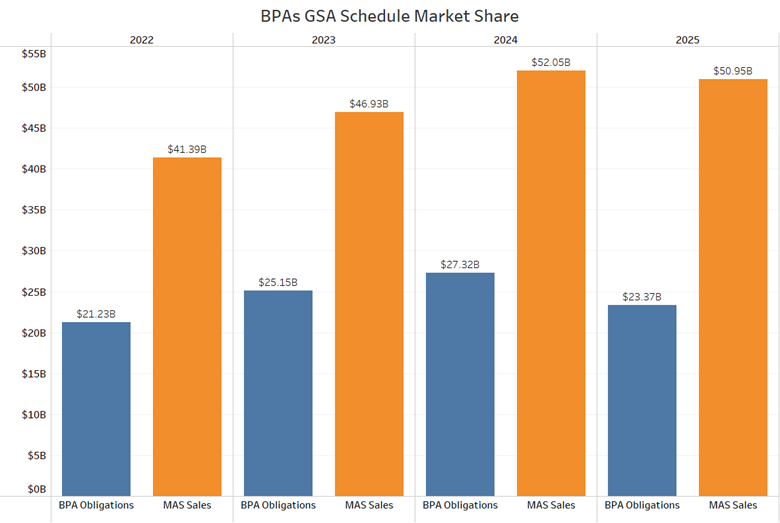
As the chart demonstrates, MAS BPAs play a significant, positive role in supporting agency missions. Now, the opportunities for customer agencies to leverage BPAs have increased thanks to the Revolutionary Federal Acquisition Regulation (FAR) Overhaul (RFO).
The RFO made significant, common-sense regulatory changes that will expand the effectiveness and overall use of BPAs under multiple award contracts. First, the MAS ordering procedures, now found at General Services Acquisition Regulation (GSAR) Subpart 538.71, expanded the potential use of single award BPAs. Competition for single award MAS BPAs for agency specific requirements is one of most effective ways to increase value and lower total acquisition costs for customer agencies and the American people. The Coalition for Common Sense for Government Procurement (Coalition) has consistently supported the expansion of the use of single award MAS BPAs as a market driven, best value procurement tool.
Second, the RFO authorizes the establishment of BPAs under all multiple award contracts. See RFO 16.507-2(c)(3). As a result, governmentwide contracting programs like OASIS+, NASA SEWP VI, and Alliant 3 will now have greater flexibility to leverage repetitive requirements to achieve greater efficiency and lower performance costs. BPAs under the IT governmentwide acquisition contracts (GWACs) now provide a procurement management function that will support agency-specific program missions in an even more efficient and effective manner. Likewise, agency-specific multiple award contracts can now leverage this authority as part of their acquisition strategy. The key trigger for the authorization is that the underlying multiple award contract includes language specifically authorizing BPAs at the competitive ordering level.
These common-sense regulatory changes will create dynamic opportunities that will enhance competition, lower costs/prices, and achieve best value for customer agencies. The framework has been set, and formal rulemaking will finalize these changes. The ultimate key to success will be the ability of the acquisition workforce to creatively and effectively utilize BPAs. Training is critical. Identifying and sharing best practices across government will help ensure the potential of BPAs is fulfilled. The RFO eliminates the checklist approach to procurement and rightly invests the acquisition workforce with great discretion in executing the mission. Training, professional development, and communication are foundational to the long-term success of the RFO.
The Coalition stands ready to work with all stakeholders in identifying best practices that support the efficient and effective procurement tools that deliver best value mission support for the American people.