See You Next Week at the Spring Training Conference!
The Coalition for Common Sense in Government Procurement is looking forward to welcoming attendees next week for the 2026 Spring Training Conference, taking place May 13-14 at the Fairview Park Marriott in Falls Church, Virginia.
Over the course of two days, government and industry leaders will come together to discuss the evolving federal acquisition landscape, including governmentwide acquisition priorities, emerging technologies, procurement policy developments, and key trends shaping the federal marketplace.
The New GSA for the Revolutionary Federal Market
A key focus of this year’s conference will be the General Services Administration’s (GSA) evolving Federal Acquisition Service (FAS) organizational structure. Attendees will have the opportunity to hear directly from leaders across GSA’s newly established FAS organizations and learn more about how these changes are designed to strengthen acquisition operations, improve outcomes, and support governmentwide procurement efforts.
Through a series of dedicated breakout discussions, attendees will explore the missions and roles of the new FAS organizations, including:
- Assist: Office of Assisted Acquisition Services
- Centralize: Office of Centralized Acquisition Services
- Create: Office of Acquisition Solutions Development
- Deliver: Office of Shared Services Delivery
- Optimize: Office of Business Optimization
The Evolving Federal Healthcare Market
Day Two of the conference will focus on “The Evolving Federal Healthcare Market,” featuring discussions with senior leaders from the Department of Veterans Affairs (VA), Department of Health and Human Services (HHS), and the Defense Logistics Agency (DLA).
Sessions throughout the day will address healthcare budget and legislative developments, VA acquisition priorities, medical supply chain challenges, contracting programs, and opportunities for industry engagement across the federal healthcare market. The agenda also includes discussions focused on VA prosthetics, DLA Medical Troop Support, VA pharmacy programs, and VA medical and surgical supplies.
Interactive Tabletop and One-on-One Opportunities
In addition to the conference sessions and panels, attendees will also have opportunities to engage directly with government representatives through a series of interactive tabletop discussions and one-on-one meetings throughout the event. These discussions are designed to provide attendees with practical insights, answer questions, and facilitate conversations on current acquisition initiatives and programs.
Day One tabletop opportunities include:
- Transactional Data Reporting (TDR) / FAS Catalog Platform (FCP) Help Desk
- VA MSPV One-on-One Meetings
Day Two tabletop opportunities include:
- VA Office of Acquisition Logistics and Construction (OALC) Table
- VA Federal Supply Schedule (FSS) Table
These sessions provide attendees with an additional opportunity to connect directly with agency representatives and continue the conversation beyond the main conference agenda.
Join us on May 13-14!
With timely discussions and opportunities to connect with acquisition leaders and industry peers, the Spring Training Conference provides a unique opportunity to gain insight into the federal marketplace. If you have not yet registered, we encourage you to join us next week in Falls Church for this important dialogue on the evolving acquisition landscape.
To register for the Spring Training Conference, click here.
We look forward to seeing everyone next week in Falls Church!
Thank You Sponsors!

Help Spread the Word About Spring Conference!
As we count down to the 2026 Spring Training Conference, we are excited to launch our official Social Media Kit to help you spread the word! All attendees can now download customizable graphics and sample posts to share your involvement in this important event.
Let your network know you will be joining the conversation on what’s next for the federal market by using the hashtag #CGPSpring2026.
Download the Social Media Kit here.
Sign up for Med/Surg Supply BPA One-on-One Meetings
The Spring Training Conference will once again offer one-on-one meetings with VA Med/Surg Supply BPA representatives on Wednesday, May 13, in the Vienna/Falls Church Room (located downstairs from the main ballroom).
To view the sign-up schedule, click here. Please note that this schedule is for reference only and cannot be used to reserve a time slot.
Attendees should contact the individuals listed below directly to schedule a meeting.
Med/Surg Supply BPA One-on-One Meetings – May 13
- Sarah Scott – sarah.scott1@va.gov
- Melanie Stockman – melanie.stockman@va.gov
- Pete Lyke – edward.lyke@va.gov
- Takia Dunn – takia.dunn@va.gov
- Felicia Demita – felicia.demita@va.gov
Please note: Jeremy Parker will be onsite and plans to be available at the table when possible but will not be scheduling one-on-one meetings.
If you have any questions, please contact Joseph Snyderwine at jsnyderwine@thecgp.org.
GSA Announces New FAS Organizational Structure
The General Services Administration’s (GSA) Federal Acquisition Service (FAS) has announced an updated organizational structure intended to strengthen operations, improve outcomes, and increase accountability across its federal acquisition operations. According to GSA, the reorganization supports recent Executive Orders focused on workforce optimization and procurement consolidation.
As part of the restructuring, FAS operations are being consolidated into five new portfolios:
- Office of Assisted Acquisition Services (Assist)
- Office of Centralized Acquisition Services (Centralize)
- Office of Acquisition Solutions Development (Create)
- Office of Shared Services Delivery (Deliver)
- Office of Business Optimization (Optimize)
In addition, GSA established a new office, Transform, which will focus on accelerating automation efforts and implementing artificial intelligence solutions.
According to GSA, the FAS reorganization is designed to strengthen federal purchasing operations and provide contracting professionals with additional tools, training, and operational support. The agency stated that the updated structure aligns with operational changes and acquisition priorities from the current administration.
GSA also emphasized that customer agencies and industry partners should not expect immediate changes to day-to-day operations or signature acquisition programs. Programs including the Multiple Award Schedule (MAS), Governmentwide Acquisition Contracts (GWACs), CityPairs, Fleet, GO.gov, and OneGov are expected to operate as usual under the new structure.
New Executive Order Establishes Preference for Fixed-Price Contracts
The White House released an Executive Order (EO), “Promoting Efficiency, Accountability, and Performance in Federal Contracting,” establishing fixed-price contracts with performance-based considerations as the “default and preferred method of procurement” across the Executive Branch. The EO intends to improve cost predictability and budget discipline, strengthen contractor accountability, and streamline procurement and contract administration.
Under the EO, Executive Branch departments and agencies are directed, to the maximum extent of the law, to utilize fixed-price contracts as defined in Part 16 of the Federal Acquisition Regulation (FAR), or contracts that tie profit to performance-based metrics when appropriate.
The EO also requires that the use of any non-fixed-price contract, including cost-reimbursement, time-and-materials, labor-hour, or other non-fixed-price contract types, be justified in writing by the contracting officer to the agency head. In addition, agency head approval is required for non-fixed-price contracts above specified thresholds, including:
- $100 million for Department of War contracts;
- $35 million for National Aeronautics and Space Administration (NASA) contracts;
- $25 million for Department of Homeland Security (DHS) contracts; and
- $10 million for contracts involving other agencies.
Within 90 days of the EO, agency heads are also directed to review their 10 largest non-fixed-price contracts by dollar value and, to the maximum extent practicable and consistent with law, seek to modify, restructure, or renegotiate those contracts to incorporate fixed-price structures and performance-based incentives where appropriate.
GSA Rolls Out Pricing 2.0: New Pricing Algorithm for MAS Contracts
Starting on June 5, 2026 GSA will implement Pricing 2.0, a targeted refinement to their current pricing algorithm. This enhancement updates the Multiple Award Schedule (MAS) program by addressing “persistent outlier pricing.”
Key Changes from Existing Model:
- Commercial Price Anchor: The Market Baseline is now capped at the lower of the current model’s formula or the minimum observed commercial price, excluding outliers. This ensures government baseline pricing cannot drift above the best commercial rates while preserving the analytical rigor of our existing methodology.
- Adjusted Price-Proportional Premium: The price-proportional premium will be reduced by 50% from current levels. Refining this premium reduces excessive price variability for identical items, protecting taxpayers from outlier pricing while maintaining fair profit opportunities for quality contractors.
Contracting Officers will retain full authority to negotiate prices based on specific circumstances, ensuring flexibility for unique government requirements. The current method for calculating the market threshold will remain active until June 5th, 2026. Once Pricing 2.0 goes live, the updated Pricing 2.0 calculation method will replace the existing one. This update will be automatic and users do not need to take any action.
How will the Market Threshold be calculated as of June 5th?
The “market threshold” column, generated in the Compliance and Pricing (C&P) report, helps to simplify the price evaluation process by using one main number that takes into account various pricing data and trends. The following sources are used to collect pricing data, which are refreshed every two months on a rolling 12-month basis:
- Government contract prices from GSA Advantage, FedMall, and NASA SEWP.
- Government order prices from MAS Transactional Data Reporting (TDR).
- Commercial catalog prices.
GSA MAS Refresh 32 to Implement New DEI Requirements
GSA announced plans to issue Multiple Award Schedule (MAS) Solicitation Refresh 32 in June 2026, introducing a range of solicitation updates and policy changes affecting MAS contractors.
Among the most significant updates, Refresh 32 will implement Executive Order (EO) 14398 Addressing DEI Discrimination by Federal Contractors and incorporate FAR 52.222-90, which establishes that agencies should not conduct business with contractors that engage in racially discriminatory diversity, equity, and inclusion (DEI) practices. According to the notice, the changes are being implemented through GSA Class Deviation RFO-2025-12 Supplement 26-02, which revised portions of the Revolutionary FAR Overhaul (RFO) affecting FAR Parts 9, 12, and 22 to align with the EO and subsequent FAR Council guidance.
Specifically, the new Clause 52.222-90, Addressing DEI Discrimination by Federal Contractors (APR 2026), will require contractors to certify that they will not engage in racially discriminatory DEI activities, will furnish information and records requested by contracting agencies to demonstrate compliance, and report known or reasonably knowable subcontractor conduct that may violate the clause. The clause also states that noncompliance could result in contract cancellation, termination, suspension, or potential suspension and debarment actions.
GSA stated that the implementation of EO 14398 and FAR 52.222-90 will apply to both existing and future orders issued under MAS contracts. Contractors will be required to accept the associated mass modification within 30 days after issuance.
In addition to the DEI-related updates, Refresh 32 includes broader solicitation revisions across multiple Large Categories and Special Item Numbers (SINs). These changes include updates to joint venture requirements, revisions to drone-related language reflecting program management changes within the Department of War, and new requirements related to end-of-support considerations for information and communications technology equipment.
Refresh 32 will also establish a new Grants Quality Service Management Office (QSMO) Marketplace SIN under the Information Technology category as part of a joint effort between GSA and the Department of Health and Human Services (HHS) to support federal grant management modernization efforts. Other updates include revisions to various SIN descriptions, retirement of certain SINs, and additional solicitation guidance updates.
GSA plans to host a webinar on May 20, 2026, to discuss the upcoming MAS Refresh 32 changes and related mass modification requirements. Registration information can be found in the announcement.
GAO Releases Updated FY25 Contract Spending Dashboard
The Government Accountability Office (GAO) released an updated interactive dashboard that provides a snapshot of governmentwide contracting activity for fiscal year 2025. According to GAO, the federal government obligated approximately $793 billion in contract spending during fiscal year (FY) 2025, representing a $17.8 billion increase from FY24 after adjusting for inflation.
The dashboard provides insight into how federal agencies spend contracting dollars and allows users to filter and compare spending data across agencies and product categories. According to GAO, the tool can be used to identify top products and services purchased by individual agencies and compare those purchases governmentwide.
Top 5 Civilian Agency Services and Products
Total obligations (in billions)
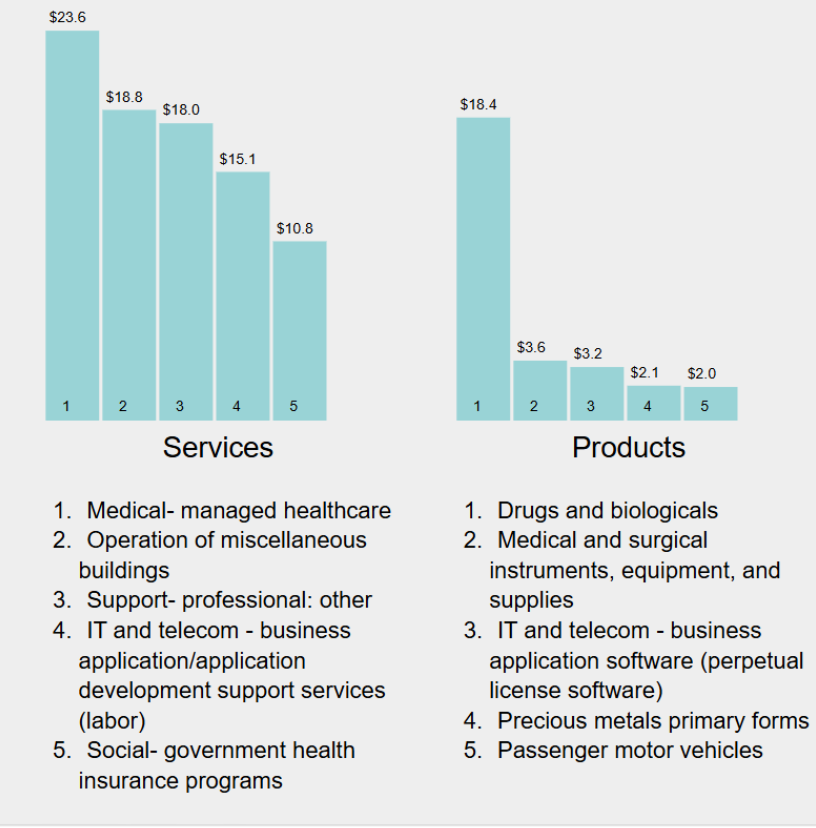
GAO reported that drugs and biologicals remained the top product purchased by civilian agencies in FY25, while fixed-wing aircraft represented the largest product category purchased by defense agencies. On the services side, professional support services continued to be the top category purchased by defense agencies. For civilian agencies, however, managed healthcare became the leading service category, replacing professional support services.
The dashboard provides greater transparency into federal procurement activity and contract trends.
GAO Releases Two Reports on VA Acquisition Operations and HTME Contracting
The Government Accountability Office (GAO) recently released two reports examining acquisition-related challenges and opportunities within the Department of Veterans Affairs (VA).
The first report, “Acquisition Reorganization Should Reflect Leading Practices,” outlines recommendations for how the VA should approach its ongoing acquisition reorganization efforts. According to GAO, the agency has previously recommended that VA take steps to centralize acquisition operations and modernize its supply chain management practices. GAO also noted that earlier reviews identified challenges related to acquisition workforce management and implementation of the VA’s Acquisition Lifecycle Framework.
According to the report, the VA has recently reduced portions of its contracting workforce while continuing to develop a broader reorganization plan for its acquisition function. In November 2025, the VA Secretary issued a memorandum initiating the realignment of all contracting offices under the Office of Acquisition, Logistics, and Construction (OALC). The memorandum directed the agency to begin implementing operational changes by March 2026, with full implementation targeted for September 2026.
GAO recommended that the VA incorporate leading practices throughout the reorganization process, including establishing clear goals and outcomes, engaging stakeholders and employees, monitoring progress, conducting strategic workforce planning, and strengthening employee engagement.
The second report focused on the VA’s acquisition of maintenance services for high-tech medical equipment (HTME). According to GAO, while the VA uses agencywide contracts intended to support equipment maintenance purchases, regional contracting officials do not consistently utilize those contracts. As a result, some medical centers reportedly duplicated contracting efforts or paid higher prices than those available through existing agencywide agreements.
GAO found that contracting officials cited difficulties navigating available contract resources and uncertainty regarding whether certain HTME base contracts were mandatory for maintenance service acquisitions.
To address these issues, GAO recommended that the National Acquisition Center (NAC) evaluate options for improving procurement of radiation therapy equipment maintenance services, including potentially modifying existing HTME contracts. GAO also recommended that the Veterans Health Administration clarify guidance regarding mandatory contract use and provide additional training and resources to contracting officials to support more effective use of HTME contracts and pricing comparisons.
FedRAMP Previews Consolidated 2026 Rules
The Federal Risk and Authorization Management Program’s (FedRAMP) latest blog unveiled a preview of the program’s Consolidated 2026 Rules. The rules, which are expected to be finalized by the end of June, will provide guidance and expectations for cloud service providers (CSPs) and govern the program through 2028.
According to the blog, the Consolidated 2026 Rules will outline timelines for major changes to both the traditional Rev. 5 pathway and the new FedRAMP 20x pathway. By publishing their expectations in advance, FedRAMP hopes to help CSPs better plan future offerings and prepare for upcoming security requirements.
The blog also explains that the Rev. 5 pathway will transition away from FedRAMP-provided templates toward machine-readable structured requirements. In addition, the rules will outline the third phase of the FedRAMP 20x Pilot and provide insight into when the new pathway will be fully implemented.
FedRAMP is encouraging interested parties to provide feedback on the Consolidated Rules as content is added to the preview webpage. Comments may be submitted directly through GitHub, which hosts the site. Users must sign into a GitHub account and authorize the Giscus application to participate.
The Consolidated Rules are expected to take effect in July 2026, with optional transition periods in some cases extending through January 1, 2027. The rules will remain in effect through December 31, 2028, when a new set of consolidated rules is expected to take effect.
VA Highlights Successful Michigan EHR Deployments
FedScoop reports that the Department of Veterans Affairs’ (VA) Electronic Health Record (EHR) modernization effort has shown signs of progress following the successful deployment of the updated system at four Michigan VA facilities earlier this month. During a Senate Appropriations subcommittee hearing, VA Secretary Doug Collins stated that the April rollout at facilities in Detroit, Ann Arbor, Battle Creek, and Saginaw “has been phenomenal, even by industry standard.” According to Collins, the sites have already processed more than 26,000 patients.
Lawmakers noted that early feedback from the Michigan deployments has been positive but also raised concerns about staffing, training, and operational support as the VA prepares to expand the rollout to additional states this summer, including Ohio, Kentucky, and Indiana. Senators questioned how the agency plans to ensure sufficient clinical and IT staffing, adequate training time, and on-site support during future implementations.
The Michigan deployments marked the VA’s first rollout of the modernized EHR system since implementation was paused in 2023. The VA’s fiscal 2027 budget request includes a 24.7 percent increase in funding for EHR modernization, totaling $4.24 billion, reflecting continued investment in the effort as the agency moves forward with additional deployments.
Army Refocuses SBIR/STTR Programs on Army-Wide Needs
Federal News Network reports that the Army is shifting its Small Business Innovation Research (SBIR) and Small Business Technology Transfer (STTR) programs to place greater emphasis on Army-wide needs and operational priorities. The SBIR and STTR programs provide research and development funding to small businesses developing innovative technologies and solutions for Department of War (DoW) requirements.
New solicitations under the programs were paused after authorization lapsed last October. Following congressional reauthorization in March, the Army quickly released five new topics for small businesses to pursue, including opportunities tied to experimentation and prize competitions.
According to the report, the new topics reflect the Army’s evolving approach under its FUZE program, which was established last September to accelerate innovation efforts across the service. The FUZE initiative embraces a “venture-capital-centric strategy” focused on broad solution discovery, targeted investments, and rapid transition to scalable production.
Under this approach, Army officials said SBIR and STTR investments will increasingly focus on technologies with strong dual-use commercial applications, particularly in areas where the private sector is investing heavily or advancing more rapidly than DoW laboratories. The Army is also emphasizing technologies that can be quickly evaluated by soldiers and incorporated into experimentation and demonstration activities to gather operational feedback earlier in the development process.
Legal Corner: FAR Council Advances Trump Administration’s Anti-DEI Goals with Issuance of Model FAR Deviation
The Legal Corner provides the procurement community with an opportunity to share insights and comments on Legal issues of the day. The comments herein do not necessarily reflect the views of The Coalition for Common Sense in Government Procurement.
Authored by Alejandra Montenegro Almonte; Connor W. Farrell; Scott N. Flesch; Elissa B. Harwood; Nate Lankford; Katherine E. Pappas; Ashley Powers; Alejandro (Alex) L. Sarria; Jason N. Workmaster; Miller & Chevalier
The Federal Acquisition Regulatory Council (FAR Council) published a memorandum on April 17, 2026, directing agency procurement officials to implement Revolutionary FAR Overhaul (RFO) class deviations and take immediate steps to carry out the administration’s latest executive order targeting diversity, equity, and inclusion (DEI) in federal contracting. Executive Order (E.O.) 14398, “Addressing DEI Discrimination by Federal Contractors,” issued on March 26, 2026, left little discretion to the FAR Council, providing the text of the required definitions and contract clause and an aggressive implementation timeline. Contractors should expect the new clause to appear in new solicitations and modifications to existing contracts and open solicitations immediately.
Far from a routine regulatory update, the new mandatory FAR clause elevates compliance with the new FAR clause prohibiting “racially discriminatory DEI,” making it an express condition of eligibility to do business with the federal government. The E.O. and implementing guidance make explicit the severe penalties for non-compliance, including contract termination, suspension, debarment, and False Claims Act (FCA) exposure, but do little to clarify the boundaries of the conduct that constitutes a violation. Notably, both the E.O. and the implementing RFO deviations apply only to discrimination based on race and ethnicity. Gender and sexual orientation, protected characteristics addressed by prior “illegal DEI” orders, are absent.
Immediate Impact of the FAR Council’s Memorandum
The changes implemented by the new guidance apply to nearly all federal contracts and “contract-like instruments,” including contracts for commercial products and commercial services, as well as subcontracts at all tiers. The only contracts not subject to the new requirements are those below the micro-purchase threshold and contracts performed and delivered entirely outside the U.S. The following deadlines apply to all other contracts and solicitations:
- April 24, 2026: Agencies must begin incorporating the new clause, FAR 52.222-90, Addressing DEI Discrimination by Federal Contractors (APR 2026) (DEVIATION APR 2026), into all new solicitations and resulting contracts.
- April 27, 2026: Agencies must revise their class deviations for FAR Parts 9, 12, 22, and 52 to conform to the FAR Council’s model deviations.
- July 27, 2026: Agencies must modify all existing contracts that extend beyond December 31, 2026, to include FAR 52.222-90. Contracting officers (COs) may use discretion to decide which contracts ending before that date should be modified. Although the guidance refers to “bilateral” modifications, contractors and subcontractors that refuse to accept the clause could face termination for convenience.
Requirements of the New Clause (FAR 52.222-90)
The new clause, taken directly from the E.O., imposes a series of compliance and reporting obligations on prime and subcontractors. Contractors must:
- Certify that they do not engage in any “racially discriminatory DEI activities.”
- Acknowledge that violations may result in suspension and debarment, in addition to contract termination.
- Provide access to all records, documents, and information necessary “for purposes of ascertaining compliance.”
- Flow down the clause to subcontractors of all tiers, including those providing commercial products and services.
- Report any “known or reasonably knowable” violations by subcontractors and comply with agency-directed remedial actions.
- Notify the CO if a subcontractor initiates litigation challenging the validity of the clause.
- Acknowledge that certification of compliance is material to the government’s payment decisions, increasing potential exposure under the FCA.
Expansion and Implementation of the Administration’s Anti-DEI Agenda
The latest guidance from the FAR Council is a significant step forward in implementing the administration’s expressed policy position of removing DEI from federal contracting. The underlying March 2026 E.O., which we explained in more detail here, was itself an escalation of the administration’s efforts to eliminate affirmative action, equity-related preferences, and diversity and inclusion initiatives from government contracting. Those efforts began on the first day of President Trump’s second term with earlier orders, including E.O. 14151, “Ending Radical and Wasteful Government DEI Programs and Preferencing,” and E.O. 14173, “Ending Illegal Discrimination and Restoring Merit-Based Opportunity,” which targeted “unlawful DEI.” While E.O. 14398 limits its scope to DEI programs based on race and ethnicity, it expands the conduct potentially covered and the severity of the consequences for violations.
The order characterized DEI activities as “unethical and often illegal,” raising the possibility that it prohibits actions the administration views as discriminatory even if they are not illegal. The E.O.’s definitions, now incorporated into agency RFO deviations, are broad. They encompass not only hiring and promotion decisions, but also the “allocation or deployment of an entity’s resources.” The order also increases risk by tying compliance failures to present responsibility determinations, raising the prospect of enterprise-wide eligibility consequences rather than merely contract-specific penalties.
FAR Council Guidance and Required Class Deviations
To implement the E.O., the FAR Council issued model class deviations that agencies must adopt without variance unless they seek approval from the Council. The additions are in tension with the RFO’s stated goal of eliminating most non-statutory clauses and streamlining compliance obligations, particularly for contracts involving commercial products and services.
By April 27, 2026, agencies must revise their RFO deviations to include the following:
- Part 9 (Contractor Qualifications)
- FAR 9.406-2(b)(1)(viii) adds failure to comply with FAR 52.222-90 as a basis for debarment.
- FAR 9.407-2(a)(11) adds the same failure as a basis for suspension.
- Part 12 (Acquisition of Commercial Products and Commercial Services)
- FAR 12.205(a)(3) is revised to require inclusion of FAR 52.222-90 in contracts for commercial products and commercial services.
- Part 22 (Application of Labor Laws to Government Acquisitions)
- Adds new Subpart 22.22, defining “program participation” and “racially discriminatory DEI activities,” and mandating inclusion of FAR 52.222-90 in applicable solicitations and contracts.
- Part 52 (Solicitation Provisions and Contract Clauses)
- Adds FAR 52.222-90 as drafted by E.O. 14398.
- Revises FAR 52.244-6 to include 52.222-90 as a required flowdown in subcontracts for commercial products and commercial services.
Reporting Burden and Audit Risk
The FAR Council sought emergency approval from the Office of Management and Budget (OMB) under the Paperwork Reduction Act for the additional reporting burden imposed by FAR 52.222-90. In its submission, the Council estimated 6,825 audits would occur this year. It projected that contractors will require an average of 70 minutes to respond to an initial records request, while government personnel will spend 16 hours reviewing submissions.
The modest time estimate for contractors, despite the clause’s requirement to provide access to “all information and reports, including books, records, and accounts,” suggests that contractors may receive limited time to respond to audit requests. While OMB approval is still pending information collection to support audits, the FAR Council’s memorandum authorizes agencies to begin requesting records immediately in connection with investigations.
FCA Exposure
Contractors have been on notice of the government’s interest in using the FCA as an enforcement tool against DEI. The Department of Justice (DOJ) announced the Civil Rights Fraud Initiative in May 2025, a task force dedicated to using the FCA to pursue recipients of federal funds who knowingly violate civil rights law. The new FAR clause’s language requiring contractors to acknowledge that compliance is material to the government’s payment decisions is designed to smooth one hurdle to FCA claims, but contractually designating DEI compliance as material won’t be dispositive in court. Even if it carries weight, FCA liability still requires scienter. Given the lack of clear guidance on what constitutes “racially discriminatory DEI activities,” proving that a contractor knowingly submitted a false certification may present challenges for the government.
Litigation Challenging E.O. 14398
On April 20, 2026, a coalition of higher education and government contractor associations filed suit in Maryland district court seeking to enjoin enforcement of E.O. 14398. National Association of Diversity Officers in Higher Education, et al. v. Trump, No. 8:26-cv-01532 (D. Md.). The plaintiffs contend that the E.O. imposes an unlawful “diversity ban” on contractors based on the incorrect assertion that DEI is inherently discriminatory. The lawsuit challenges the policy on the grounds that it chills protected speech, constitutes a content-based violation of the First Amendment, and exceeds the president’s authority under the Federal Property and Administrative Services Act (FPASA).
The litigation follows a February 2026 decision by the U.S. Court of Appeals for the Fourth Circuit vacating a preliminary injunction against E.O. 14173, in which the court held that requiring recipients of federal funds to certify compliance with antidiscrimination laws was not facially unconstitutional, while leaving open the possibility of as-applied challenges.
Open Issues for Contractors
Key unresolved issues include:
- How DEI initiatives related to protected classes other than race and ethnicity will be incorporated into contracting regulations and whether previous orders addressing “illegal DEI” still control when certifying compliance with all applicable laws.
- When and how similar obligations will be incorporated into grants, other transaction agreements, and other “contract-like instruments.”
- Whether FPASA authorizes the president to direct FAR class deviations and dictate mandatory clause text, and if it does, what impact notice and comment rulemaking can have on a clause set forth in an executive order.
- How ongoing litigation will affect enforcement.
- Whether courts will give weight to the clause’s express acknowledgment of FCA materiality.
- How federal requirements will interact with state and local contracting and employment obligations.
- Whether the implementation of E.O. 14398 will have a chilling effect on contractors seeking to enter the federal marketplace.
Conclusion
The FAR Council’s implementation of E.O. 14398 represents a fundamental shift in how DEI-related issues are regulated in federal contracting. Contractors should treat compliance with FAR 52.222-90 as a high-risk, enterprise-wide obligation requiring immediate, coordinated attention from legal, compliance, human resources, contracting, and executive leadership. Until clearer guidance emerges, whether through rulemaking or litigation, risk management and documentation will be critical.
VA Medical/Surgical Prime Vendor (MSPV) Make PPE in America Industry Day, May 12
The Department of Veterans Affairs (VA) is excited to announce the upcoming MSPV Make PPE in America Industry Day on May 12, 2026. This event is intended to bring together suppliers, manufacturers, and industry stakeholders involved in the production and distribution of Personal Protective Equipment (PPE) to support the VA’s Medical/Surgical Prime Vendor Program. Our goal is to foster collaboration, share valuable insights, and enhance the procurement and supply chain processes for PPE necessary to serve our veterans and healthcare providers effectively.
This event will be held in conjunction with the Coalition for Government Procurement (CGP) Spring Training Conference, which will take place on May 13–14, 2026, at the same venue. Attendees interested in participating in the CGP Spring Training Conference can find more details and register below.
* Personal protective equipment, as applied to this Industry Day announcement, means surgical masks, N95 masks, respirator non-surgical masks and powered air purifying respirators and required filters, face shields and protective eyewear, disposable and reusable surgical and isolation gowns, head and foot coverings, and other gear or clothing used to protect an individual from the transmission of disease. All items must be in compliance with the “Infrastructure Investment and Jobs Act” (IIJA) PL 117-58, and the “Make Personal Protective Equipment (PPE) in America Act”. Additionally, this Industry Day event will exclude gloves. Additionally, any information from industry awareness for specific PPE items that may have no compliant items available is welcome.
** Representatives will be available from the CGP to register for their Spring Training Conference during the Industry Day event.
VA’s MSPV Program is looking for:
- PPE Manufacturers and Suppliers
- PPE Medical/Surgical Product Distributors
- Industry Stakeholders
- Supply Chain Management Professionals
Why attend the Make PPE in America Industry Day?
- Understand the VA’s MSPV Program and its impact on PPE procurement.
- Learn about the VA’s current and future PPE requirements.
- Network with key VA officials and industry leaders.
- Gain insights into the VA’s procurement processes and opportunities.
- Showcase your innovative PPE products and solutions.
We look forward to your participation in this informative and engaging event as we work together to ensure the safety and well-being of our veterans and healthcare providers.
Event Details:
Date: Tuesday May 12, 2026
Time: Booth/Table 8:00am – 9:00am; MSPV/MSPO opening statements 9:15am – 9:30am Location: Fairview Marriott, Falls Church, Virginia
Event Fee: The Industry Day event on May 12 will be free of charge.
NO VIRTUAL ATTENDANCE – THIS IS AN INDIVIDUAL BOOTH PRESENTATION & TOUCH AND FEEL EVENT
MSPV Make PPE in America Industry Day Agenda:
- Welcome and Introduction
- VA’s MSPV PPE Procurement Needs and Processes
- Q&A Session
- Supplier Presentations and Innovations in PPE (individual times will be on a signup sheet in the future)
Registration Information Industry Day (no cost):
Please register for the MSPV Make PPE in America Industry Day event by 12:30pm Eastern on April 7, 2026 to Matthew McDonell Matthew.McDonell@va.gov and Sarah Scott Sarah.Scott1@va.gov with the following information in the body of the message:
- Company name and direct contact information
- Attendee Count
- SB Status (if any)
- SAM UEI and DUNS
- PPE Product
If you have any questions for the Coalition regarding the Industry Day, please contact Joseph Snyderwine at JSnyderwine@thecgp.org.
Please note that registration for the Spring Training Conference (May 13-14) and Industry Day (May 12) is separate. For more information on the Spring Training Conference and to register, click here.
VA Expands Healthcare Network with 35 New Clinics
According to reports, the Department of Veterans Affairs (VA) has opened 35 new medical facilities since January 20, 2025, as part of a broader effort to expand access to care for veterans nationwide. According to the report, the expansion includes outpatient clinics, specialty treatment centers, community-based facilities, and larger regional medical campuses intended to support growing demand for VA healthcare services.
The report notes that the expansion effort is focused in part on improving access to care in underserved and rural areas, where veterans often face long travel distances for specialty treatment and other healthcare services. Several newly opened facilities are intended to provide expanded access to primary care, mental health services, rehabilitation, imaging, laboratory services, and specialty care closer to where veterans live.
The VA also recently highlighted that more than 100,000 veterans enrolled for care between January 1 and March 31, 2025, reflecting continued growth in demand across the VA healthcare system. According to the report, the increase in enrollment has added pressure on the agency to expand both infrastructure and staffing resources.
The facility expansion effort is separate from the VA’s ongoing Electronic Health Record (EHR) modernization initiative, which continues to move forward through phased deployments despite ongoing oversight and implementation challenges.
Off the Shelf: An in Depth Look at the Revolutionary Federal Acquisition Regulation
Jeff Koses, Senior Procurement Executive at the General Services Administration (GSA), joined Off the Shelf to discuss the vision and goals behind the Revolutionary Federal Acquisition Regulation (RFO) initiative.
During the discussion, Koses outlined the role of the FAR Council in the federal rulemaking process, including how the Office of Management and Budget (OMB), GSA, the Department of War (DoW), and NASA collaborate to develop FAR rules consistent with statutes and Executive Orders.
Koses also explained how the FAR Council utilized class deviations to meet the administration’s accelerated implementation timelines for the RFO effort. In addition, he highlighted the increasing reliance on guidance documents, including Practitioner’s Albums, to support the acquisition workforce as the FAR framework evolves.
The conversation also explored broader RFO changes intended to streamline acquisition processes and reduce regulatory burdens for both government agencies and industry partners.
Listen to the full interview here.
GSA & VA Schedule Contracting Training for In-House Counsel, May 12
The Coalition is proud to once again host its “must attend” General Services Administration (GSA) and Veterans Affairs (VA) Schedule Contracting Training for In-House Counsel on May 12! This course is designed for lawyers and contract managers at member companies with significant contract management and compliance responsibilities with GSA and/or VA Schedule contracts.
Our presenters for the day will be Robert Burton, Partner, Crowell & Moring; Ken Dodds, Executive Vice President & General Counsel, The Coalition for Common Sense in Government Procurement; and Jason Workmaster, Member, Miller & Chevalier Chartered;
During the training, Robert, Ken, and Jason will cover the following topics and more:
- Pricing – Transactional Data Reporting (TDR)/Commercial Sales Practices (CSP);
- Domestic Preferences;
- Supply Chain;
- Enforcement/Mandatory Disclosure/Ethics;
- Sustainability Requirements/Policy; and
- Bid Protests Update.
Reasons to Attend:
After successfully completing this course, you will receive 6 CLE credits, while also gaining an understanding of:
- GSA/VA’s most favored customer pricing policy and major requirements of the government solicitation;
- Current audit/oversight procedures;
- Current GSA Schedule Price Negotiation Priorities; and
- How the GSA Schedule can impact your company’s bottom line.
Plus, you will be able to advise your in-house clients regarding topics such as:
- Disclosure of company records;
- Establishing management and compliance processes;
- Establishing ethics programs and mandatory disclosure;
- Avoiding penalties; and
- Identifying resources to assist with continuing legal support of your internal GSA/VA Schedule programs.
Who Should Attend:
This training course is excellent for:
- In-house counsel for current GSA/VA Schedule contractors and/or companies considering becoming a GSA/VA Schedule contractor;
- Government attorneys that advise clients with GSA/VA Schedule contracts;
- Contract Managers with MAS experience; and
- Compliance Personnel.
The training will be held at GDIT, Falls Church, VA, Time: 9:30 AM – 3:30 PM (ET). Virtual attendance is also offered for the course. We look forward to your participation!
To register, click here. For assistance with registration, please contact Mady Whiting at mady.whiting@thecgp.org.