A Great Day at Whiskey Creek in Support of Veterans
On behalf of The Coalition for Common Sense in Government Procurement (Coalition), we extend our sincere gratitude to all our members, sponsors, and participants who joined us on Wednesday for the 13th Annual Joseph P. Caggiano Memorial Golf Tournament. With beautiful weather and a great turnout, it was a wonderful day at Whiskey Creek Golf Club as the government contracting community came together for golf, networking, and giving back to two important causes supporting veterans. Thanks to your generosity and participation, this year’s tournament was another tremendous success.

We are thrilled to share that this year’s tournament raised $15,000 for Paws for Purple Hearts. Attendees also had the special opportunity to meet Waldron, the service dog named in honor of Coalition President Roger Waldron. Now about a year old, Waldron and his Paws for Purple Hearts trainers gave attendees a brief demonstration and update on how his training is progressing as he continues learning the skills that will one day help him support a veteran. It was wonderful to welcome Waldron to the tournament and see his progress firsthand!
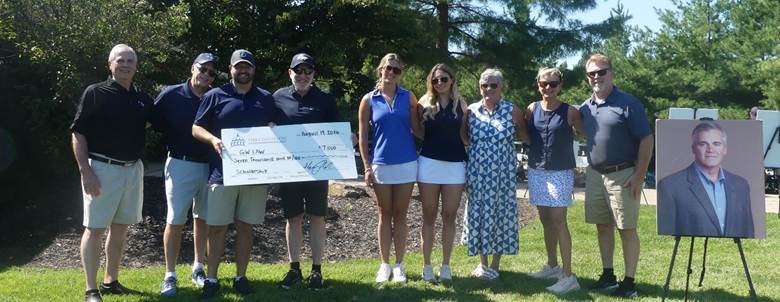
In addition, the tournament raised $7,000 for The George Washington University (GWU) Government Procurement Law Program through the Coalition Endowed Scholarship Fund. The scholarship supports veterans pursuing educational opportunities at GW Law School in the field of government procurement.
Altogether, this year’s tournament raised over $22,000 in support of these two important causes. We are incredibly grateful to everyone whose participation and generosity helped make that possible.
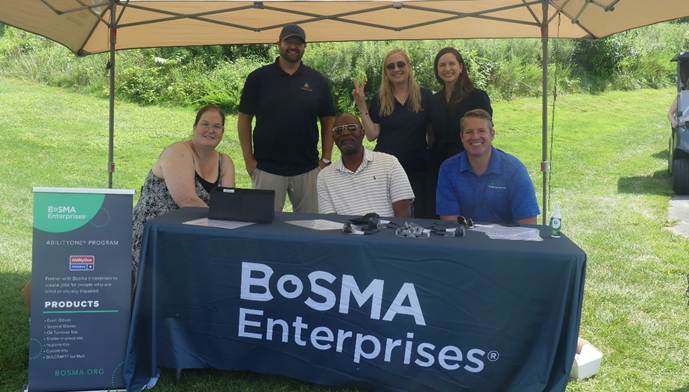
This success would not have been possible without the tremendous support of our sponsors. We extend a special thank you to our Title Sponsor, Bosma Enterprises, for its generous support of this year’s tournament and for bringing a unique, hands-on experience to Hole #1.
As an AbilityOne federal contractor, Bosma gave golfers the opportunity to tee off while wearing vision impairment simulation glasses. The activity offered participants a firsthand glimpse into the challenges associated with different types of vision loss while raising awareness of Bosma’s mission to support individuals who are blind or visually impaired.
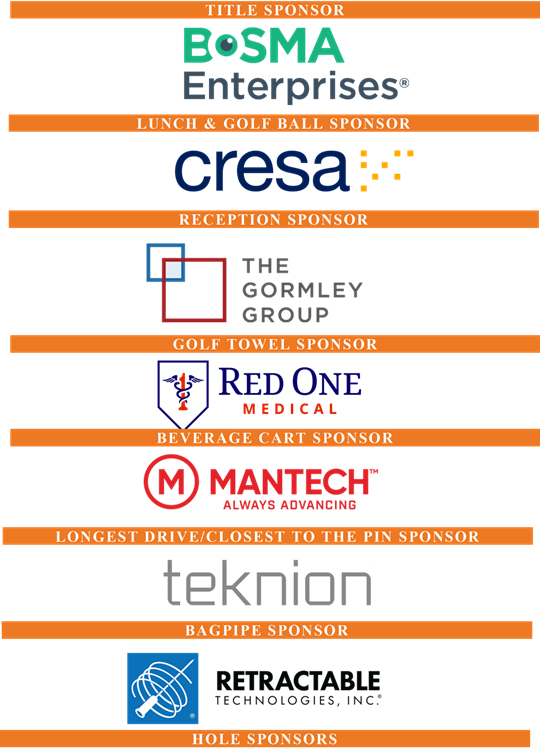
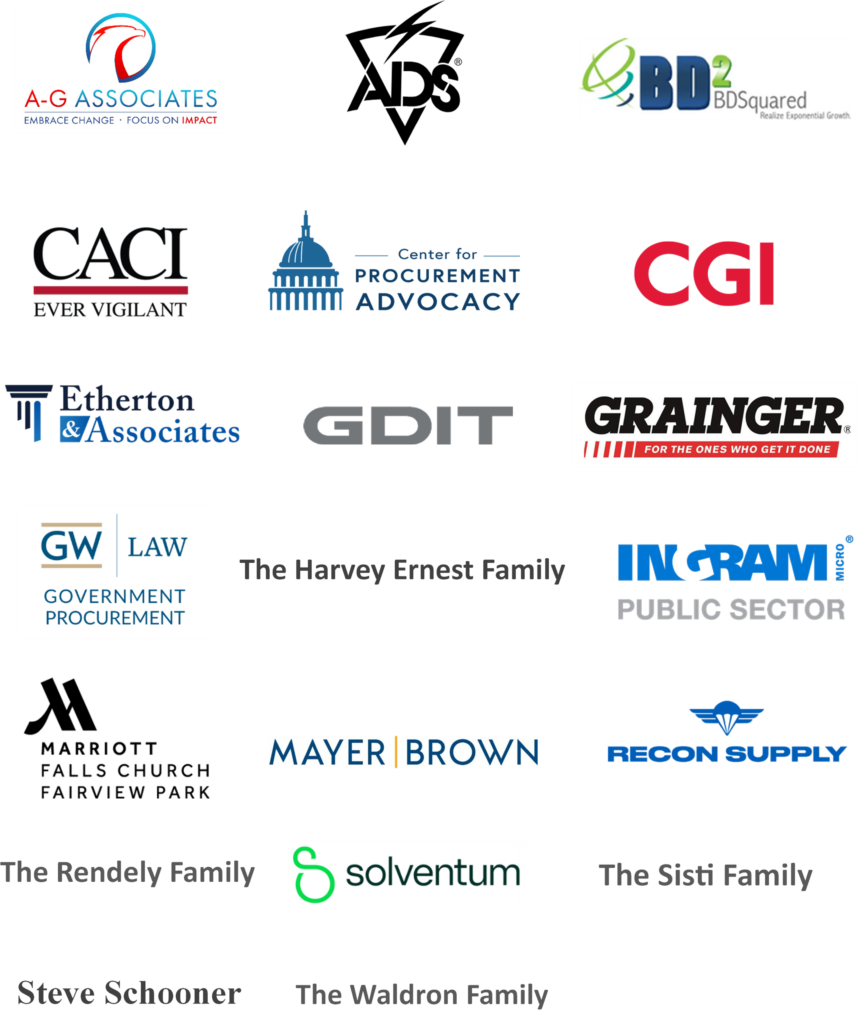
We sincerely thank this year’s sponsors for their generosity and commitment to making the tournament and its charitable impact possible.

We also want to recognize the many great performances on the course and congratulate this year’s tournament and contest winners. Congratulations to the first-place team of Shalom Atkinson, Blake Hinckley, Cirelo Manego,and Leonard Long. In addition, congratulations to our Longest Drive Contest winners, Leonard Long and Zoey Hatsios, as well as the Closest to the Pin Contest winner, Terry Hobson. Thank you to everyone who joined us on the course!
Thank you once again to our members, sponsors, participants, Paws for Purple Hearts, GWU Law School, Whiskey Creek Golf Club, and everyone who helped make the 13th Annual Joseph P. Caggiano Memorial Golf Tournament such a memorable day. Together, we continue to honor Joe’s legacy while supporting veterans through service and education. We look forward to welcoming everyone back next year for another great day on the course!
Join the VA FSS Industry Day, Aug 26
Join us for the virtual Department of Veterans Affairs (VA) FSS Industry Day with the VA Federal Supply Schedule (FSS) program next Wed., August 26 from 10 AM to 12:00 PM (ET).
The VA FSS Program will provide updates on:
- VA FSS Organization and Initiatives
- Sharon Chang, VA FSS Director
- VA FSS Solicitation
- Joshua Ladwig, FSS Chief, Contract Support Division
- VA Pharmaceutical Schedule
- Diana Lawal, FSS Chief, Pharmaceutical/Dental B Division
- Isabel Uribe, FSS Chief, Pharmaceutical/Dental A Division
- VA Med/Surg Schedule
- James Booth, FSS Chief, Medical/Surgical A Division
- Deborah Zuckswerth, FSS Chief, Medical/Surgical B Division
- Joshua Ladwig, FSS Chief, Medical/Surgical Division C
For the full agenda, click here.
To register, click here. For any assistance with registration, please contact Mady Whiting at mady.whiting@thecgp.org
Note: This is a members-only event. If you see a message that says “Registration Not Available” please log in using your member account.
GSA Calls on AbilityOne to Verify Country-of-Origin Information
The General Services Administration (GSA) sent a letter to the U.S. AbilityOne Commission requesting that the Commission more thoroughly verify the country of origin of products it sells. The AbilityOne Procurement List is a mandatory source, meaning agencies generally must purchase listed products and services through the program when applicable.
GSA’s letter identifies specific products with potentially inaccurate country-of-origin information. According to GSA, AbilityOne associated merchandise, including technology products such as flash drives, docking stations, and portable charging packs, has been identified on the Procurement List as “Country of Origin: USA” when in fact it is made in China and other countries.
GSA requested that the Commission conduct a full audit of all items offered for sale through GSA, including the identification of all Countries of Origin (COO) of its products in the Federal Acquisition Service Verified Product Portal, by November 12. GSA also plans to eliminate the exception that permits the Commission to offer Chinese-made products.
Coalition Urges GSA to Make Schedule Program “Evergreen”
On August 12, the Coalition submitted a letter to the General Services Administration (GSA) regarding evergreen Federal Supply Schedule (FSS) contracting.
The letter encourages GSA to consider an evergreen approach to FSS contracting as the agency implements acquisition reforms associated with the Revolutionary FAR Overhaul and new FSS ordering procedures.
View the letter here.
Coalition Submits Comments on the Future of CMMC
Last Friday, the Coalition submitted comments in response to a Department of War Request for Information (RFI) on the Cybersecurity Maturity Model Certification (CMMC) program. The RFI requested feedback on how to maintain cybersecurity protections under CMMC while reducing compliance and administrative costs of the program. The DOW paused the phased implementation of the program in mid-July. The Coalition continues to monitor next steps for the CMMC program.
SBA Proposes Changes to Small Business Size Standards
The Small Business Administration (SBA) has issued a proposed rule that would establish new size standards for 338 industry groups and industries. According to SBA, the proposed standards are intended to better reflect the markets in which small businesses compete.
As part of the proposal, SBA would simplify its size standards by moving from nearly 1,000 individual standards based primarily on six-digit NAICS codes to 338 standards using a combination of four- and five-digit NAICS codes. SBA is also proposing to eliminate size standard exceptions and shift numerous industries from receipt-based to employee-based standards.
SBA is not proposing to reduce any existing industry size standard, including in 45 industries where its analysis indicated a potential decrease.
SBA is seeking public comments on the proposed rule. Comments are due September 21, 2026.
GSA OIG on the Accuracy of MAS Product Data
A recent GSA Office of Inspector General (OIG) audit report identified issues with how GSA Advantage! and Transactional Data Reporting (TDR) systems capture product information. The report, which analyzed data from February and June 2024, found that the systems lacked “accurate and consistent manufacturer names and part numbers.”
According to the OIG, inaccurate or inconsistent product data can prevent GSA pricing tools, including the Price Point Plus Portal (4P Tool) and Compliance & Pricing Reporting Portal (CPRP), from correctly identifying identical products. The report noted that Multiple Award Schedule contractors may modify manufacturer part numbers to differentiate product configurations. While GSA provides tools for contractors to report inaccuracies in product data, their use is voluntary.The following FAS chart shows how data flows between its IT systems that collect and analyze part numbers.
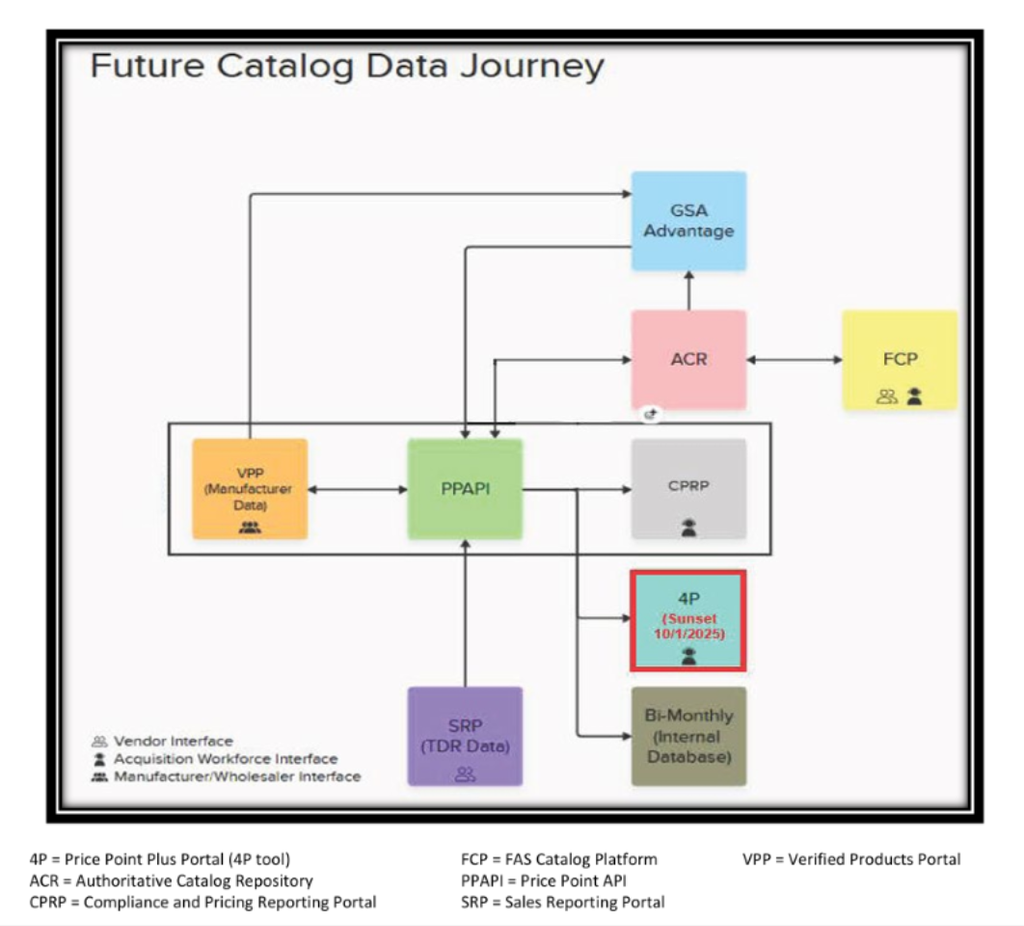
The OIG made six recommendations to GSA’s Federal Acquisition Service (FAS). Acting FAS Commissioner Laura Stanton partially concurred with five recommendations and fully concurred with the sixth.
GSA Plans to Extend OneGov AI Deals
FedScoop reports that GSA plans to extend some of its limited-time OneGov artificial intelligence (AI) deals, while other companies may offer new deals as the agency continues negotiating with industry. GSA Office of IT Products Director Birgit Smeltzer said that several original equipment manufacturers (OEMs) have already agreed to extend offers, while others are considering new ones.
Three major AI deals with OpenAI’s ChatGPT, Google’s Gemini, and Anthropic’s Claude are set to expire next month. GSA has stated that these deals have already saved the government $1.4 billion and provided access to AI tools for approximately 3.4 million federal employees.
GSA Provides Advance Notice of MAS Refresh 33
GSA’s Federal Acquisition Service (FAS) announced plans to issue GSA Multiple Award Schedule (MAS) Refresh 33 in September 2026. The associated mass modification must be accepted by subject contractors within 90 days of issuance.
Key proposed changes include:
- New provisions and clauses formalizing supply chain risk management (SCRM) practices
- Expansion of FASt Lane eligibility across the entire MAS solicitation
- New requirements related to product substitutions
- Updated Service Contract Labor Standards (SCLS) wage determinations
Refresh 33 also includes updates to selected Special Item Numbers (SINs) within the Facilities, Miscellaneous, and Travel Large Categories, including revisions to certain SIN descriptions, Statements of Work (SOWs), and Price Proposal Templates (PPTs).
GSA FSA will host a public webinar on September 1, 2026, to discuss the upcoming refresh and mass modification.
OFPP Administrator Rhodes to Depart September 4
Federal News Network reports that Dr. Kevin Rhodes, Administrator of the Office of Federal Procurement Policy (OFPP), will leave federal service on September 4.
Rhodes was confirmed by the Senate in October 2025, becoming the first permanent OFPP administrator since 2019. He previously joined the Office of Management and Budget (OMB) as a senior advisor in February 2025.
During his tenure, Rhodes helped lead the ongoing overhaul of the Federal Acquisition Regulation (FAR). In June, the FAR Council released proposed rules covering 17 FAR parts, with additional proposed rules expected in the coming months. Dr. Rhodes also oversaw efforts to modernize the government’s Cost Accounting Standards.
It is not yet clear who will serve as acting OFPP administrator following Dr. Rhodes’ departure. His exit comes as the government continues work on the FAR overhaul and other federal acquisition reform initiatives.
Coalition President on the Evolving Role of VARs
Last week, Coalition President Roger Waldron spoke during a George Mason University’s Baroni Center event titled “Challenges and Expectations for VARs and Resellers Across the Federal Enterprise.”
The event explored the evolving role of value-added resellers (VARs) as federal agencies increasingly procure cloud services, software subscriptions, and other digital capabilities. The discussion addressed what “value added” means in today’s federal marketplace, the opportunities and challenges facing VARs and resellers, and how government and industry can work together to support effective acquisition outcomes.
Watch the recording to hear Roger and fellow panelists share their perspectives on the critical role of VARS and resellers in the federal market. To access the recording, click here.
DoW Seeks Greater Contractor Pricing Transparency
Breaking Defense reports that a Department of War (DoW) memorandum, signed by Deputy Defense Secretary Steve Feinberg, calls for the Department to more aggressively seek cost and pricing information from contractors.
The directive applies to contracts valued at more than $10 million, with an exception for contracts involving purely commercial off-the-shelf (COTS) items. The memo directs the Under Secretary of War for Acquisition and Sustainment (USW(A&S)) to establish fair and reasonable contract profit margins.
The memo also calls for DoW to explore an automated method for directly accessing cost information from contractors’ internal systems and to strengthen enforcement of Cost and Software Data Reporting (CSDR) requirements. Contractors with delinquent CSDR submissions would be required to provide the information within 30 days.
The memo notes that the policies are not intended to “limit profitability” when contractors identify and achieve efficiencies.
VA Plans EHR Contract Ceiling Increase, Extension
MeriTalk reports that the Department of Veterans Affairs (VA) is seeking to increase the ceiling and extend its contract for the agency’s Electronic Health Record Modernization (EHRM) program.
According to an August 11 notice posted to SAM.gov, the VA said it expects to reach the contract’s current ceiling, which is nearly $10 billion, by the first quarter of fiscal year 2027 due to “unanticipated complexities” associated with deploying the EHR system. The amount of the proposed ceiling increase was not publicly disclosed.
The VA is also proposing three one-year optional ordering periods that could extend the contract through May 16, 2031. The current contract is scheduled to expire in May 2028.
As of July 2026, the VA had deployed the EHR system at 14 of its 164 medical centers. Deployments resumed in April following a pause that began in 2023, and the VA has additional deployments scheduled throughout 2026 and 2027.
Registration Now Open: Coalition Compliance Training Conference, Oct. 7
The Coalition is pleased to announce the first in a new series of Compliance Training Conferences designed to help the government contracting community navigate evolving compliance risks and responsibilities. The inaugural half-day training conference will take place the morning of October 7 and will be hosted by CGI Federal in Arlington, Virginia, bringing together government, industry, and legal experts for timely discussions on some of the most important compliance issues facing federal contractors.
We are excited to offer an early look at several of the sessions already planned for the program.
Procurement in the Age of AI: Ethics & Compliance in a Changing Federal Marketplace

The conference will feature a keynote session, “Procurement in the Age of AI: Ethics & Compliance in a Changing Federal Marketplace,” presented by Jessica Tillipman, Associate Dean for Government Procurement Law Studies at The George Washington University Law School. The session will examine emerging AI-related risks across the procurement lifecycle and supply chain, including organizational conflicts of interest, AI-enabled fraud and False Claims Act exposure, algorithmic collusion, system manipulation, and over-reliance on automated judgment. It will also explore practical compliance considerations for contractors as AI becomes increasingly integrated into their organizations, subcontractors, and federal procurement activities.
Active Bystandership: The Missing Link in Corporate Risk Reduction

Attendees will also hear from Jonathan Aronie, Partner at Sheppard, during “Active Bystandership: The Missing Link in Corporate Risk Reduction.” Active Bystandership is a practical approach that equips employees with the skills and confidence to intervene early when they see a colleague moving toward a potential mistake or compliance problem. Already used in high-stakes environments including aviation, healthcare, law enforcement, and the military, the approach offers contractors another tool for strengthening organizational culture and preventing problems before they result in costly compliance or enforcement issues.
Compliance and the Civil False Claims Act
The conference will also include a panel on “Compliance and the Civil False Claims Act,” featuring Alex Canizares, Partner at Vinson & Elkins; Terra Fulham, Special Counsel at Covington; and Tirzah Lollar, Partner at Arnold & Porter.
Additional speakers from government and industry are being invited to participate, and more program details will be announced in the coming weeks.
Stay tuned to next week’s Friday Flash for the opening of registration and additional details about the Coalition’s October 7 Compliance Conference!
Legal Corner: SBA to Propose Massive Changes to Its Small Business Size Standards
The Legal Corner provides the procurement community with an opportunity to share insights and comments on Legal issues of the day. The comments herein do not necessarily reflect the views of The Coalition for Common Sense in Government Procurement.
Authored by Jon Williams, Meghan F. Leemon; PilieroMazza
On August 20th, SBA will publish stunning proposed changes to its size standards, replacing the August 2025 proposed rule, which we discussed here, as well as revised size standards methodology. From time to time, SBA reviews and proposes changes to its size standards and those changes are typically incremental and to adjust for inflation. Tomorrow’s proposed changes are massive and will dramatically reshape how small businesses are determined for federal contracting if finalized.
One of the major proposed changes is to shift from revenue to employee-based size standards in many industries. For example, all the construction-related NAICS codes in NAICS Sectors 236 and 237 currently have revenue-based size standards ranging between $19 and $45 million. SBA is now proposing to change all of the construction industries to employee-based size standards, with the new size standards ranging between 550 and 2,000 employees depending on the industry. For example, a firm currently operating in the other heavy and civil engineering construction industry, NAICS code 237990, qualifies as small if its average annual revenue over the past five completed fiscal years is less than $45 million. But under SBA’s new proposal, firms would qualify under the broader Construction NAICS Sector 23713 if their average employees per pay period over the last 24 months is less than 1,500 employees. This means significantly larger and more firms would now qualify as small for construction.
In addition, SBA is proposing to change the NAICS level at which size standards are calculated, which will reduce the number of individual size standards. Along these lines, this will also result in SBA removing all size standard exceptions. Currently, many NAICS codes have certain exceptions to size standards for various subindustries. One of these is the exception for NAICS code 541519, Information Technology Value Added Resellers (ITVAR), which currently has a size standard of 150 employees. ITVAR is not addressed directly in the proposed rule, but with the proposed shift to 4- or 5-digit NAICS levels to determine size standards, it appears that the size standard could be changing to $531 million. It is unclear how this will comport with the performance of work requirements for ITVARs performing on set-aside contracts.
Another major proposed change is the dramatic increase in most (but not all) of the current revenue-based size standards. To provide a few examples, the table below compares the current and proposed new size standards for several professional services industries. The magnitude of the proposed changes is readily apparent from the percentage increase, the lowest of which reflects an increase of more than 200%.
| NAICS | Current Size Standard | Proposed Size Standard | % Increase |
| 541310, Architectural Services | $12.5M | $135M | 980% |
| 541511, Custom Computer Programming Services | $34M | $531M | 1462% |
| 541611, Administrative Management and General Management Consulting Services | $24.5M | $295M | 1104% |
| 541990, All Other Professional, Scientific and Technical Services | $19.5M | $61M | 213% |
| 561210, Facilities Support Services | $47M | $156M | 232% |
| 561611, Investigation and Personal Background Check Services | $25M | $186M | 644% |
| 562910, Remediation Services | $25M | $113M | 352% |
SBA explains that its proposals will increase industrial base resilience, participation in SBA loan programs, and satisfaction of small business goals by dramatically increasing the number of small businesses in federal contracting. While true, it is not clear if SBA considered the other side of that equation – namely, firms that currently qualify as small businesses would now have to compete for small business set-aside contracts against much larger and more sophisticated firms.
For example, a consulting firm averaging approximately $20M per year in revenue currently competes for small business set-asides against other similarly-sized firms with revenue below $24.5M. But if the proposed increases are finalized, the $20M business would have to start competing for small business set-asides against businesses with average annual revenue of nearly $300M. The resources, number of personnel, and sophistication of a $300M company will unquestionably surpass a $20M business. This may end up having the opposite effect that SBA intended by driving many smaller firms out of federal contracting because they cannot hope to compete against firms that are 15 times (or more) their size.
Indeed, it seems unavoidable that the massive size standard increases will significantly harm the competitive viability of many businesses that qualify as small under the current size standards. Also, the significant proposed increases may decrease the attractiveness of SBA’s mentor-protégé program and mentor-protégé joint ventures, as more mentors may now qualify as small and, as a result, would not need to enter into a mentor-protégé agreement to form a joint venture to qualify as small. While larger small businesses could still utilize the mentor-protégé program now as protégés, the mentor-protégé program has been an important tool for newer and smaller firms that may now find it harder to attract willing mentors.
On the other hand, the proposed changes address the so-called “mid-tier cliff” experienced by firms that are no longer small but are not large enough to compete against the biggest contractors in full and open procurements. Over the years there has been talk of creating a separate set-aside program for mid-tier firms. Instead of a separate set-aside program, the proposed size standard increases would turn many mid-tier firms back into small businesses.
Additionally, the changes could improve the exit strategy options for small business owners and turbo charge M&A activity amongst small business contractors. With much more room to grow under the new size standards, small businesses could use mergers and acquisitions to scale up and compete in the new landscape. And many small businesses would likely have a more robust market of potential buyers that would be able to maintain their existing set-aside contracts, deemphasizing the significance of SBA’s oft-criticized recertification rules. In these ways, the new rules could make existing small business sellers more valuable targets.
Public comments will be due 30 days after the date of publication. Assuming the proposed rule is published tomorrow, comments will be due on or around September 19. We recommend all potentially affected firms submit comments, whether you are in favor of or against SBA’s proposals.
If you would like to discuss SBA’s proposed changes and how they may impact your company and your business strategy, please contact the authors of this alert, Jon Williams and Meghan Leemon, members of PilieroMazza’s Government Contracts Practice Group.
Proposed Changes for Small Businesses in the FY 2027 NDAA, August 27
Moshe Schwartz, President of Etherton and Associates, Inc., and the Coalition’s Defense Fellow, on August 27 from 12:00 – 1:00 PM (ET) will provide a webinar on the proposed small business provisions in the pending National Defense Authorization Act (NDAA) of 2027.
To register, click here. For any assistance with registration, please contact Mady Whiting at mady.whiting@thecgp.org.
GSA Assisted Acquisition Services (AAS) Briefing, September 30
The Coalition’s GWAC/MAC Committee will host a meeting on September 30, at 10:00 AM (ET). Pete Burr, Assistant Commissioner of GSA’s Office of Assisted Acquisition Services (AAS) will provide an update on AAS and its current priorities, followed by an opportunity for dialogue and discussion.
The meeting will be held in person in the DMV area (location TBA). Virtual attendance will also be supported.
To register, click here. For any assistance with registration, please contact Mady Whiting at mady.whiting@thecgp.org
Note: This is a members-only event. If you see a message that says “Registration Not Available” please log in using your member account.