Far and Beyond Blog
Announcing the Fall Training Conference Day One Agenda: The Acquisition Exchange — What’s Next for Interagency Contracting?
The Coalition for Common Sense in Government Procurement (Coalition) is excited to release the Day One agenda for the 2026 Fall Training Conference: The Acquisition Exchange, taking place November 18–19 at the Fairview Park Marriott in Falls Church, Virginia.
Day One, “The Acquisition Exchange: What’s Next for Interagency Contracting?”, will bring together government and industry leaders for a full day of discussions focused on the future of the federal acquisition marketplace. As agencies continue to evolve their acquisition strategies, programs, and contracting approaches, the agenda will examine what these changes mean for both government and industry. Attendees will hear directly from acquisition leaders and experts on emerging priorities, the connection between acquisition policy and operations, and the programs and initiatives shaping interagency contracting. The day will also provide opportunities for attendees to engage directly with government officials through focused breakout sessions covering key acquisition offices, contract vehicles, and systems.
Day One Main Stage
Keynote Address – “Post Election: What Happened, Where Are We, and Where Are We Going?”

Following welcome remarks, the conference will begin with a keynote address from former Congressman Tom Davis, Partner at Holland & Knight, who will present “Post Election: What Happened, Where Are We, and Where Are We Going?” Davis will provide attendees with a timely look at the 2026 election results and what they could mean for the policy and political landscape moving forward.
The Nexus Between Policy & Operations
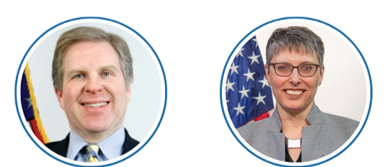
Next, Jeff Koses, Senior Procurement Executive at the General Services Administration (GSA), and Laura Stanton, Acting Commissioner of GSA’s Federal Acquisition Service (FAS), will take the stage for “The Nexus Between Policy & Operations.” The session will explore the connection between acquisition policy and its implementation across federal procurement operations.
Legislative & Budget Update

Attendees will then hear from Moshe Schwartz, Coalition Defense Fellow and President of Etherton and Associates, for “Budget & Legislative Updates.” Schwartz will discuss the latest developments on Capitol Hill and the federal budget and legislative issues impacting government contractors.
Luncheon Keynote with GSA CAO

Following the networking lunch, Greg Justice, Chief Acquisition Officer at GSA, will deliver the luncheon keynote address, offering attendees another opportunity to hear directly from GSA leadership about the acquisition landscape.
Procurement Hot Topics
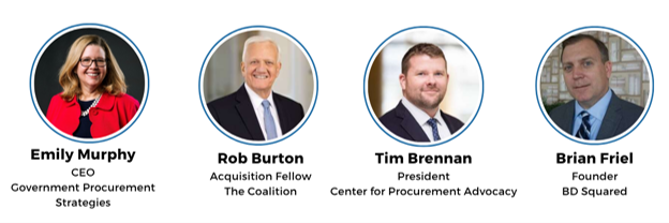
The main-stage program will conclude with “Procurement Hot Topics,” featuring Emily Murphy, CEO of Government Procurement Strategies; Rob Burton, Coalition Acquisition Fellow; Tim Brennan, President of the Center for Procurement Advocacy; and Brian Friel, Founder of BD Squared. This panel will bring together top procurement experts to discuss the latest issues, trends, and developments impacting the federal market.
Nuts & Bolts Breakouts
Following the main-stage program, attendees will have the opportunity to choose from a series of Nuts & Bolts Sessions designed to provide a closer look at key acquisition programs, offices, systems, and initiatives.
The first round of breakout sessions will feature:
- ASSIST: Office of Assisted Acquisition Services
- CENTRALIZE: Office of Centralized Acquisition Services
- CREATE: Office of Acquisition Solutions Development
- DELIVER: Office of Shared Services Delivery
A second round will feature:
- Multiple Award Schedule Listening Session
- OneGov
- NASA SEWP
- FAS Systems
These smaller sessions will give attendees an opportunity to engage with government leaders and hear directly about the latest priorities and developments across these programs and offices.
We look forward to bringing the government contracting community together for a full day of timely discussions, practical insights, and opportunities to engage directly with acquisition leaders.
To view the full Day One agenda, click here. Please note all speakers are invited unless otherwise noted as confirmed.
Register today for the 2026 Fall Training Conference and join us on November 18 for The Acquisition Exchange!
Secure your Sponsorship for the 2026 Fall Training Conference
Sponsorship opportunities are still available and are currently being secured for the Fall Training Conference! Organizations interested in showcasing their brand and supporting this premier procurement event are encouraged to review the 2026 Fall Training Conference Sponsorship Prospectus for additional information. If you have any questions or are ready to secure your sponsorship, please contact Heather Tarpley at htarpley@thecgp.org.
Thank You to Our Current Sponsors

Invest in Success: Coalition Compliance Training Conference
What should government contractors know about False Claims Act compliance and enforcement?
The False Claims Act continues to be a critical area of compliance for companies doing business with the Federal government. Understanding the latest enforcement perspectives and key compliance considerations can help contractors identify potential risks and strengthen their approach to compliance.
At the Coalition’s inaugural Invest in Success: Compliance Training Conference on October 7, attendees will hear directly from government and industry experts during “Compliance and the Civil False Claims Act.”

Chris Terranova, Assistant Director, Civil Fraud Section, Commercial Litigation Branch at the Department of Justice; Alexander Canizares, Partner at Vinson & Elkins; Terra Fulham, Special Counsel at Covington & Burling; and Tirzah Lollar, Partner at Arnold & Porter, will provide perspectives on the False Claims Act and key compliance considerations for government contractors
View the full agenda here.
To register, Click here. For any assistance with registration, please contact Mady Whiting at mady.whiting@thecgp.org
Registration Now Open! AInAcquisition Exchange Forum, Nov. 17
Registration is now open for The Coalition for Common Sense in Government Procurement’s inaugural AInAcquisition Exchange Forum on November 17 at the Fairview Park Marriott in Falls Church, Virginia.
The half-day forum will bring together government and industry leaders for a timely discussion on the growing role of artificial intelligence across the federal marketplace. Attendees will hear perspectives on how AI is being used across government, as well as the evolving acquisition policies and considerations shaping its adoption.
The forum will include “The Evolving AI Acquisition Policy Landscape,” a panel examining the latest developments and considerations shaping how the federal government acquires and adopts AI. The Coalition has invited the following government and industry experts to participate in the panel (participation is pending confirmation):
- Jessica Tillipman, Associate Dean for Government Procurement Law, The George Washington University Law School
- Michelle Miller, Director for Contract Policy, Office of the Principal Director, Defense Pricing, Contracting, and Acquisition Policy (DPCAP), Office of the Under Secretary of War for Acquisition and Sustainment, Department of War
- Mathew Blum, Associate Administrator for Federal Procurement Policy, Office of Management and Budget
- Nick West, Director, Office of Acquisition Policy, Integrity, & Workforce, General Services Administration
The AInAcquisition Exchange Forum will take place the day before the Coalition’s 2026 Fall Training Conference. Additional details, including the full agenda, confirmed speakers, and registration information, will be announced soon.
To register, click here. For questions or assistance with registration, please contact Madyson Whiting at mady.whiting@thecgp.org
Senate Launches Bipartisan Caucus to Focus on AI
Nextgov/FCW reports that Sens. John Hickenlooper (D-CO) and Dave McCormick (R-PA) launched the Senate Bipartisan Science and Innovation Caucus to support U.S. scientific research, innovation, and competitiveness. The caucus will focus on issues including artificial intelligence (AI) policy and regulation, as well as the economic and national security implications of emerging technologies.
According to Hickenlooper, the caucus plans to begin examining AI issues in the near term as lawmakers seek to balance innovation with potential risks. The caucus will also explore policies that strengthen the U.S. scientific enterprise and support technological leadership.
DLA Moves Toward ‘Digital Employees’ as AI Use Expands
Nextgov/FCW reports that the Defense Logistics Agency (DLA) is moving toward using autonomous AI agents as “digital employees,” building on its growing use of robotic process automation and generative AI. DLA currently has roughly 185–190 bots operating autonomously, which saved an estimated 300,000 hours of work in 2025.
DLA CIO Adarryl Roberts said the agency is exploring a shift from traditional bots to “agentic agents” that can operate around the clock. As a result, DLA employees must build trust in AI-generated outcomes and learn to manage the agents alongside human workers. As DLA expands its AI capabilities, it already has tools and training in place, including access to ChatGPT, Grok, and Gemini through the Department of War’s generative AI platform, as well as GenAI training for employees. Its AI Center of Excellence oversees the safe and responsible integration of AI, including access controls for AI agents.
DoW Memo Lays out Rules for AI Powered Software Development
MeriTalk reports that a recent Department of War (DoW) Instruction entitled “Accelerated Mission Software” provides new guidance and procedures for artificial intelligence (AI)-assisted software development by the DoW. The instruction was published August 31 and went into effect September 8. The document includes security, accountability, and transparency requirements for those developing software with AI tools. The guidance ensures software developers and development teams remain fully accountable for code generated or augmented by AI. It also requires that the same rigorous security testing and code review processes applied to manually written code is applied to AI augmented code. Data security is emphasized as well. “Non-public DOW information, including code, configuration scripts, infrastructure definitions, schematics, or documentation” may only be provided to AI applications or services that “reside on DOW information systems and are approved for use by DOW personnel.” The instruction establishes how the department will record the “models, versions, and significant datasets” used in AI-augmented software creation, similar to a software bill of materials (SBOM). Beyond AI, the instruction directs the agency to prioritize existing software, open-source software, and commercial-off-the shelf-software over custom built software.
Draft Guide for Testing Commercial Off-the-Shelf Products Open for Comment
The Government Accountability Office (GAO has released a draft of a new guide outlining best practices for Federal agencies to use when testing and evaluating commercial off-the-shelf (COTS) products before purchase. The guide is intended to help agencies determine whether commercially available products meet their requirements, make informed purchasing decisions, and reduce the risk of wasteful spending.
The guide is designed for agency testing and evaluation practitioners, program managers, and procurement officials, as well as oversight organizations and vendors. GAO is seeking public feedback on the draft through Dec. 14, 2026. Comments can be submitted to TEGuideComments@gao.gov.
SBA to Fast Track Defense Companies Joining the 8(a) Program
Washington Technology reports that the Small Business Administration (SBA) is establishing a fast track for defense companies looking to join the 8(a) Business Development Program. The 8(A) Business Development Program is designed to help small businesses owned by socially and economically disadvantaged individuals win contracts with the government. SBA identified the following 10 North America Industry Classification System (NAICS) Codes as essential to the defense industrial base.
- NAICS 332992: Small Arms Ammunition Manufacturing
- NAICS 332993: Ammunition (except Small Arms) Manufacturing
- NAICS 336414: Guided Missile and Space Vehicle Manufacturing
- NAICS 336413: Other Aircraft Parts and Auxiliary Equipment Manufacturing
- NAICS 334511: Search, Detection, Navigation, Guidance, Aeronautical, and Nautical System and Instrument Manufacturing
- NAICS 334419: Other Electronic Component Manufacturing
- NAICS 331110: Iron and Steel Mills and Ferroalloy Manufacturing
- NAICS 332710: Machine Shops
- NAICS 332999: All Other Miscellaneous Fabricated Metal Product Manufacturing
- NAICS 336611: Ship Building and Repairing
Eligibility will be determined by whether a company’s primary registration falls under one of these NAICS codes. Washington Technology found that only about 1.2% of current 8(a) applicants are within these NAICS codes.
DISA Accepting Offers for $21.6B Cloud Contract
MeriTalk reports that the Defense Information Systems Agency (DISA) has opened bidding on the potential 10-year, $21.6 billion Joint Warfighting Cloud Capability Unified Cloud Marketplace (JWCC UCM) Core contract. The contract will provide the Department of War with secure, multi-vendor cloud services worldwide. A solicitation notice posted to SAM.gov on Sept. 8 calls for offers to be submitted by Oct. 6.
The multiple-award IDIQ is open to U.S.-based hyperscale commercial cloud providers and will support infrastructure, platform, and software as a service offerings. UCM Core is the first tier of DISA’s broader Unified Cloud Marketplace which will expand access to commercial cloud capabilities beyond the current JWCC contract. Additional UCM tiers are expected to provide opportunities for non-hyperscale providers, SaaS and PaaS companies, and emerging technology vendors.
GAO Urges GSA to Assess EIS Transition Impacts
The Government Accountability Office (GAO) reports that the transition from legacy telecommunications contracts to the Enterprise Infrastructure Solutions (EIS) contract was delayed by more than three years, prompting repeated extensions of legacy contracts through May 2026 and increasing costs for agencies.
GAO found that vendor performance issues, COVID-19-related challenges, and legacy network connections contributed to the delays. According to the report, the General Services Administration (GSA) has not yet determined whether agencies experienced service disruptions during the transition.
As planning begins for the EIS follow-on contract, GAO recommended that GSA assess whether agencies experienced disruptions and evaluate the effectiveness of mitigation efforts.
VA MSPV Posts Q4 RFQ
The Department of Veterans Affairs has posted a request for quotes (RFQ) for the Medical Surgical Prime Vendor Program’s (MSPV) Quarter 4 FY 26 Open Market solicitation. This solicitation is structured as a tiered evaluation to maximize Service-Disabled Veteran-Owned Small Business and Veteran-Owned Small Business (SD/VOSB) participation. Quotations will be evaluated based on “technical criteria and price”. VHA clinicians will participate in evaluating all supplier quotations. Awards will be made using comparative analysis. All items are original equipment manufacturer products, and only the items listed can be quoted. The VA is not seeking “like” or substitute items.
Offers are due on October 15, 2026, at 4:00 PM CDT.
Postponed: VA Non-Expendable Equipment Virtual Industry Day
The VA FSS has delayed the VA Federal Supply Schedule (FSS) Program Non-Expendable Equipment Webinar scheduled for today, September 18, 2026. The event will be rescheduled for early October. The new date will be announced soon on the VA FSS Community page on GSA Interact.
SBA Hosts Listening Session on Small Business Size Proposed Rules
The Small Business Administration (SBA) held a virtual public forum on the recent Revised Size Standards Methodology and Small Business Size Standards proposed rules. The public was given an opportunity to share their most urgent feedback for SBA. There were hundreds of attendees who attended the forum that shared a variety of perspectives and concerns with the two proposed rules. Multiple attendees highlighted concerns that rapidly raising the small business size thresholds could lower the number of participants in the federal market, by disincentivizing participation by the smallest businesses. Multiple participants requested SBA conduct further research into how the new size standards will impact government contracting. Participants also requested that SBA take an incremental approach to increasing the size standards rather than the dramatic change outlined in the small business size standard proposed rule.
GSA Plans October Release Date for Refresh 33
GSA’s Federal Acquisition Service (FAS) has announced that Multiple Award Schedule (MAS) Refresh 33 is being rescheduled to October to ensure that updates are fully and appropriately integrated ahead of release.
FAS also added further updates to the Significant Changes document reflecting revisions to the Statement of Work (SOW) and Price Proposal Template (PPT) for SIN 561510, Travel Agent Services, under the Travel Agent and Misc Services (L03) subcategory.
Read the notice on GSA Interact here.
DoW Moves to Replace Cost Accounting Standards with GAAP
Federal News Network reports that the Department of War (DoW) is moving to replace government-unique Cost Accounting Standards (CAS) with Generally Accepted Accounting Principles (GAAP). The purpose is to reduce barriers for commercial companies seeking to do business with the Department.
A September 15 memo directs the Department to move toward GAAP, the accounting framework commonly used throughout the commercial sector. The shift is intended to reduce government-unique compliance requirements throughout the defense supply chain.
Under the new approach, DoW will request cost and pricing data when necessary to support transparency and fairness. Companies will not be required to establish new accounting systems or use special data formats to provide this information. Data provided to the Department will be limited to authorized government purposes and will not be made available to other companies for their own use.
The move is part of a broader effort to reduce government-unique requirements and expand participation in the defense industrial base. The Federal Government has also been working to bring CAS requirements into closer alignment with GAAP, including recent actions by the Office of Management and Budget and the Cost Accounting Standards Board to eliminate or substantially revise several standards.
Questions remain about how quickly the new approach will be incorporated into contracts and how it will interact with existing cost and pricing data requirements. The Department has 30 days to review how the military services are implementing requirements reform.
FAR Council Publishes Next Batch of RFO Proposed Rules
The Federal Acquisition Regulation Council published four proposed rules that continue to codify the Revolutionary FAR Overhaul (RFO). The RFO aims to remove non-statutory requirements from the FAR, empowering contracting officers to make better, more rapid procurement decisions. Previous rulemaking has codified updates to FAR Parts 1, 2, 3, 4, 5, 6, 7, 10, 18, 24, 26, 29, 33, 37, 39, 40, 41, 49, and 53. The proposed rules cover the following:
- 14 (Sealed Bidding)
- 28 (Bonds and Insurance)
- 36 (Construction and Architect-Engineer Contracts)
- 52 (Solicitation Provisions and Contract Clauses)
- 8 (Required Sources of Supplies and Services)
- 12 (Acquisition of Commercial Products and Commercial Services)
- 13 (Simplified Acquisition Procedures)
- 15 (Contracting by Negotiation)
- 38 (Federal Supply Schedule Contracting)
- 44 (Subcontracting Policies and Procedures)
- 51 (Use of Government Sources by Contractors)
- 52 (Solicitation Provisions and Contract Clauses)
- 16 (Types of Contracts)
- 17 (Special Contracting Methods)
- 35 (Research and Development Contracting)
- 52 (Solicitation Provisions and Contract Clauses)
- 9 (Contractor Qualifications)
- 27 (Patents, Data, and Copyrights)
- 47 (Transportation)
- 52 (Solicitation Provisions and Contract Clauses)
Comments on the proposed rules are due October 18. The Colation is collecting comments on these proposed rules. If you have comments, please email them to Greg Waldron at gwaldron@thecgp.org by the close of business October 2.
Legal Corner: DOJ Launches the National Fraud Detection Center
By J. Ryan Frazee, John Prairie, Arun G. Rao, Findley Penn-Hughes & Ravi Shah; Mayer Brown
The Legal Corner provides the procurement community with an opportunity to share insights and comments on Legal issues of the day. The comments herein do not necessarily reflect the views of The Coalition for Common Sense in Government Procurement.
The Department of Justice (DOJ) has announced the launch of the National Fraud Detection Center (NFDC), a new prosecutor-led, multi-agency unit tasked with investigating those who defraud federal government programs. This initiative was previewed by an August 13, 2026 memorandum outlining the National Fraud Enforcement Division’s Enforcement Priorities (the McDonald Memo) (see our August 18 Legal Update), and is being led by Acting Assistant Director Amanda Riedel of the Executive Office for U.S. Attorneys (EOUSA) and Acting Chief Cody Matthew Herche of the Global Trade & Commerce Enforcement Section, formerly head of DOJ’s Trade Fraud Task Force (TFTF). The NFDC operates as part of President Trump’s Task Force to Eliminate Fraud, the whole-of-government initiative established by Executive Order 14395 and chaired by the Vice President, as outlined in our March 18 Legal Update.
The NFDC’s Purpose
The NFDC is designed to increase cross-program visibility. Individual agencies have historically tracked fraud within their own programs but sometimes had difficulty detecting schemes spanning multiple federal programs simultaneously. The NFDC seeks to address this shortcoming by embedding analysts from across the Inspector General community and leveraging shared technology to generate criminal leads that drive prosecutions.
The Center’s inaugural partners include the FBI, Homeland Security Investigations, IRS Criminal Investigation, FinCEN, the Treasury Department, the Pandemic Response Accountability Committee, and Inspectors General from the Departments of Agriculture, Education, Health and Human Services, Homeland Security, Housing and Urban Development, Interior, Labor, and Veterans Affairs, as well as the Defense Criminal Investigative Service, the Treasury Inspector General for Tax Administration, the Small Business Administration, and the Social Security Administration. State partners from Alabama, Florida, Georgia, Louisiana, Mississippi, Ohio, and South Carolina are also participating, providing access to investigators who can identify whether a federal suspect is appearing in state cases under a different company name or identity.
The NFDC’s Leadership Signals Seriousness of Purpose
The choice of NFDC’s leadership suggests that the unit’s creation is not merely an administrative reshuffling. Riedel is an experienced federal prosecutor with a track record of standing up large-scale, cross-agency fraud initiatives. She previously served as Director of COVID-19 Fraud Enforcement during the Biden-Harris Administration and as White Collar Coordinator for the EOUSA. Herche brings recent experience helping to develop DOJ’s trade fraud enforcement effort, serving as the head of the interagency TFTF, which recently published a new benchmark Enforcement Resource Guide and announced $1 billion in civil and criminal recoveries, penalties, forfeitures, and publicly charged losses (see our July 21 Legal Update). Together, their appointments signal that the NFDC will combine traditional white collar prosecution expertise with the data-driven, multi-agency coordination model that has characterized recent efforts related to trade and pandemic fraud enforcement.
Why Federal Contractors, Grant Recipients, Financial Institutions, and Others Should Take Notice
The NFDC’s creation should be considered alongside the August 18 final rule that formally established the National Fraud Enforcement Division and conferred upon it jurisdiction over criminal fraud, criminal tax, trade and customs fraud, fraud involving monies owed to or paid by the United States, health plan fraud, and controlled substances offenses—all of which previously sat in separate DOJ components. For most of these categories the Fraud Division now shares authority with the Criminal Division; only criminal tax and health plan fraud are assigned to it exclusively. The Division’s stated mandate to use “advanced, data-driven investigative techniques,” paired with the NFDC’s multi-agency data sharing, means that DOJ is now connecting data across tax, trade, healthcare, and federal benefits programs in ways that many companies—including financial institutions—do not yet do internally.
For federal contractors and grant recipients, the implications are significant. The NFDC’s mandate specifically encompasses fraud involving monies owed to or paid by the United States—capturing procurement fraud, grant fraud, and benefits program fraud. The McDonald Memo explicitly identifies government procurement fraud (including bid rigging, defective pricing, self-dealing, bribery, and product substitution) and benefit and grant program fraud (including student loans, veterans’ benefits, disaster relief, and small business programs) as critical priorities. With a dedicated analytics operation now funneling fraud leads to a consolidated prosecution group, backed by FBI investigative resources and Inspectors General partnerships across virtually every major grant-making agency, contractors and grant recipients face a materially different enforcement landscape than previously existed. The NFDC’s state-level partnerships add another dimension, allowing DOJ to extend its reach through state investigators.
For banks and other financial institutions, these developments are particularly significant. Many institutions maintain separate compliance teams for BSA/AML, sanctions, tax reporting, trade finance, and healthcare lending or payments. These teams sometimes operate in silos with limited data integration. DOJ, through the NFDC, is seeking to build the capacity to detect patterns across these categories—identifying, for example, whether an entity flagged for suspicious trade activity is also drawing federal benefits or submitting questionable tax filings. Companies that are unable to replicate that cross-referencing internally may find themselves on the back foot when the NFDC generates an investigative lead that spans multiple regulatory domains.
Healthcare organizations, importers, and companies participating in federally funded relief or reimbursement programs should likewise take note. The NFDC’s approach means that conduct previously policed by a single agency—a billing irregularity flagged by the HHS-OIG, a customs discrepancy identified by U.S. Immigration and Customs Enforcement Homeland Security Investigations, or a tax anomaly detected by IRS-CI—can now be cross-referenced against other federal datasets, potentially revealing broader patterns of noncompliance that a single agency would have been unlikely to have identified on its own.
Next Steps and Client Considerations
- Cross-functional compliance integration: Organizations should assess whether their compliance infrastructure allows them to connect data across business lines in the same way that DOJ now proposes to do across agencies, particularly tax, trade, government contracts, and health care.
- Proactive data monitoring: The NFDC’s emphasis on analytics-driven lead generation means that DOJ may identify potential misconduct before a whistleblower report, voluntary self-disclosure, or traditional referral. Companies should consider whether their own monitoring capabilities allow them to identify and address issues before the government does.
- Voluntary self-disclosure: The National Fraud Enforcement Division operates under the Department-wide Corporate Enforcement and Voluntary Self-Disclosure Policy announced in March 2026 (see our March 12 Legal Update). The NFDC’s enhanced detection capabilities make the calculus around self-disclosure more significant, as the window between misconduct and government detection may be narrowing.
- Broader investigative scope: Under the August 18 final rule, the Fraud Division can prosecute any federal crime it discovers during an investigation in one of its enumerated areas. A lead generated by the NFDC in one program could expand into a multi-offense prosecution without the need for referral to another DOJ component.
Healthcare Spotlight: VA IG Uses AI in Audit of Healthcare Sites
NextGov reports that the VA Office of Inspector General has been using Copilot Chat to assist in its audits of VA healthcare facilities. The artificial intelligence (AI) tool is used by investigators at the Office of Healthcare Inspections to review documents, transcripts, and other collected data. A spokesperson for the watchdog told NextGov that the AI tool is used only to help the watchdog more efficiently review the large amount of data and information that it collects during the course of its healthcare site investigations. They added that “data entered into this tool is not shared with the Department, nor does it leave the VA OIG secure environment.” The OIG said that Copilot does not make any final determinations or write any of the final reports. “VA OIG requires human review of AI output to ensure accuracy prior to the inclusion in any published report,” a watchdog spokesperson added. “Our inspection and audit teams thoroughly review AI output and confirm accuracy.”
Webinar: Navigating OTAs & Other Non-Traditional Agreements, September 24

Please join the Coalition for a webinar with Covington & Burling on September 24 from 12:00PM – 1:00PM (ET), for a discussion of non-traditional procurement opportunities.
Special Counsel Peter Terenzio and Associate Daniel Raddenbach will discuss important updates to the authorities that govern alternatives to traditional FAR-covered agreements, including Other Transaction Agreements, grants, and cooperative agreements. These include changes to the scope of the Department of War’s OTA authority and a proposed full rewrite of the regulations that govern federal financial assistance.
To register, click here. For any assistance with registration, please contact Mady Whiting at mady.whiting@thecgp.org.
Briefing from GSA’s Assisted Acquisition Service (AAS), September 30

The Coalition’s GWAC/MAC Committee will host a meeting on September 30, at 10:00 AM (ET). Pete Burr, Assistant Commissioner of GSA’s Office of Assisted Acquisition Services (AAS), Darrick Early, AAS Civilian Client Executive and Corey Nickens, AAS Innovation Client Executive will provide an update on AAS and its current priorities, followed by an opportunity for dialogue and discussion.
AAS is accepting questions head of the meeting. Please submit questions to Greg Waldron at gwaldron@thecgp.org by the COB September 23.
The meeting will be held at CACI in Reston, VA. (12021 Sunset Hills Road, Reston, VA, 20190). Virtual attendance will also be supported.
To register, click here. For any assistance with registration, please contact Mady Whiting at mady.whiting@thecgp.org
Note: This is a members-only event. If you see a message that says “Registration Not Available” please log in using your member account.